

Pakistan Awards 23 Offshore Exploration Blocks After Hiatus
May 21, 2026
Pakistan, Germany Sign €40.5m Development Cooperation Deal
May 22, 2026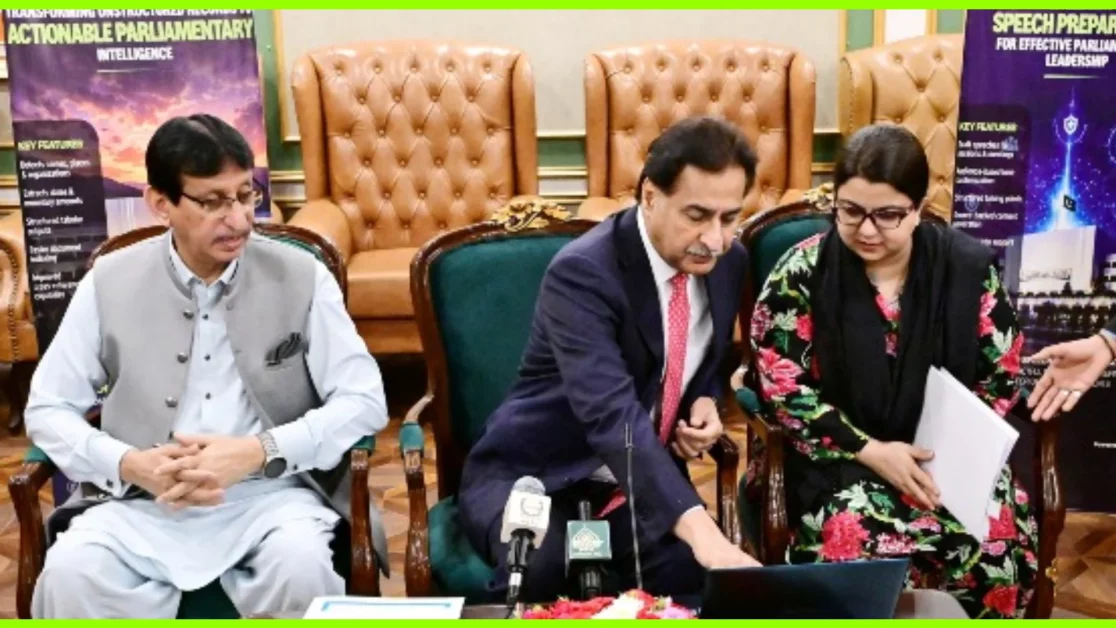
Pakistan’s National Assembly has launched the country’s first AI-enabled parliamentary system to support paperless and digital governance.
National Assembly of Pakistan has launched the country’s first AI-enabled parliamentary system, marking a major step toward digitising legislative operations and creating a paperless parliamentary environment. The initiative was formally introduced during a soft launch ceremony held at Parliament House in Islamabad under the leadership of Sardar Ayaz Sadiq.
The project, titled “AI-Powered Digital Transformation of the Speaker’s Office for Smart & Efficient Legislation,” has been developed in collaboration with the National Information Technology Board and the Ministry of Information Technology and Telecommunication. Officials described the initiative as a key milestone in Pakistan’s broader Digital Nation agenda.
Speaking at the ceremony, Speaker Ayaz Sadiq said the integration of artificial intelligence into parliamentary operations reflects the evolving needs of modern governance. He stated that digitalisation improves institutional efficiency, transparency, and speed by reducing dependence on physical documentation and manual workflows.
The National Assembly has already distributed iPads to lawmakers as part of its phased transition toward a fully paperless legislative process. According to officials, the assembly handles thousands of documents daily, and digitisation is expected to significantly streamline parliamentary business and legislative coordination.
The new AI-enabled system has been designed to assist lawmakers in accessing parliamentary records, managing legislative workflows, improving coordination between departments, and supporting informed decision-making. Officials added that the system uses a fully on-premises AI infrastructure, ensuring all parliamentary data remains hosted within Pakistan under the direct control of the National Assembly.
According to the National Information Technology Board, the platform is intended to strengthen data sovereignty, institutional security, and operational independence while modernising legislative functions. The initiative also aligns with Pakistan’s broader digital governance reforms and efforts to improve public-sector efficiency through technology adoption.
Shaza Fatima Khawaja, Federal Minister for IT and Telecommunication, described the project as an important step toward nationwide digital transformation. She reaffirmed the ministry’s commitment to supporting the National Assembly’s technological modernisation and expanding digital governance initiatives across state institutions.
Officials said training programmes are also being conducted for the National Assembly’s IT Directorate staff to strengthen technical capacity and support long-term implementation. Funds have additionally been allocated for the establishment of a modern data centre within the National Assembly to support future digital infrastructure requirements.
The initiative is also linked to sustainability goals by reducing paper consumption and improving resource efficiency. Parliamentary officials noted that the project supports broader government austerity measures while advancing environmentally responsible governance practices under the United Nations Sustainable Development Goals framework.
The launch reflects Pakistan’s growing interest in integrating artificial intelligence into governance, public administration, and institutional management as digital transformation accelerates across multiple sectors of the economy.