
HBL’s New Card Puts Pakistan’s Payment Scheme on the World Stage
July 19, 2026
The Internet Is Built on People Who Cannot Afford Privacy Anymore
July 19, 2026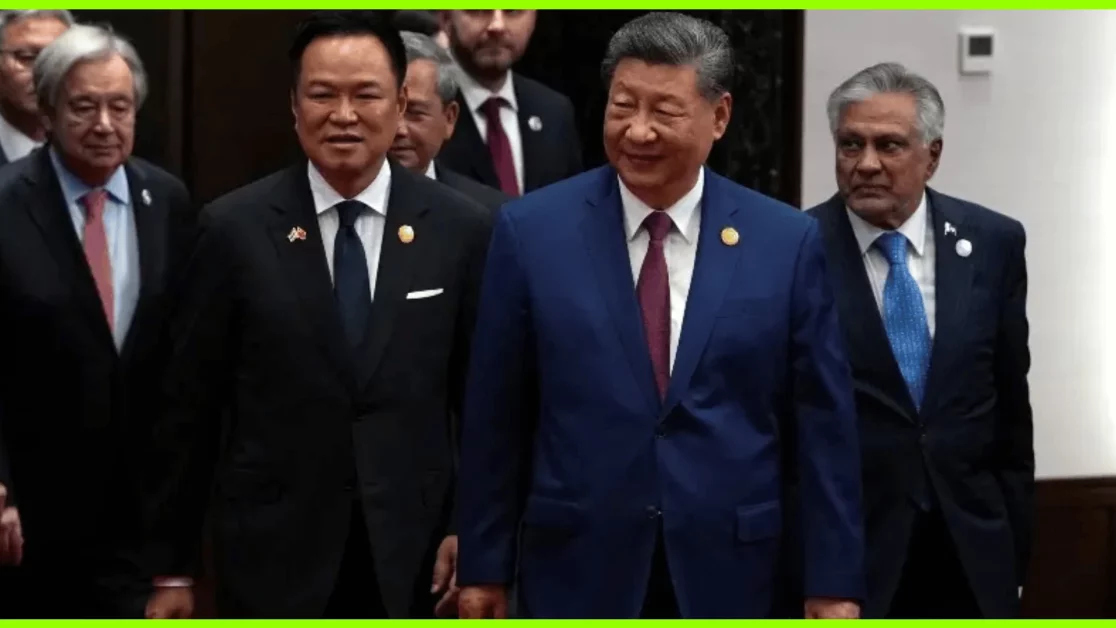
Xi Jinping used the WAIC in Shanghai to position China as the champion of open-source AI governance, challenging US dominance while Pakistan joined the new WAICO as a founding member.
The battle for control of the world’s most consequential technology just moved to Shanghai. Chinese President Xi Jinping opened the World Artificial Intelligence Conference (WAIC) on July 17 with a sweeping address that cast Beijing as the rightful leader of a new global AI order, promoting open-source technology as a global public good and warning against the emergence of “new historical injustices” from unequal access to artificial intelligence.
Comparing AI’s significance to the invention of the steam engine and electricity, Xi urged countries to “seize the rare and historic opportunity” of open-source AI and pledged to help developing nations build AI capabilities.
He called for AI systems to remain under human control, warned against loss-of-control scenarios involving autonomous systems, and urged countries to establish early-warning and emergency-response mechanisms to manage AI risks — his clearest remarks to date on AI safety.
The conference, running July 17 to 20, arrives as Washington and Beijing prepare for their first government-level AI talks under US President Donald Trump’s administration.
JXi’s address framed China’s vision as a direct rival to the US-led Pax Silica initiative, which seeks to coordinate chip and AI supply chains among allied nations, though Xi avoided naming the United States directly.
George Chen, Chair in Digital Practice at The Asia Group, described the message bluntly: “Xi’s message is clear: China is not going to follow anyone on both AI technology and standards. Instead, China is going to lead the world in both aspects.”
At WAIC, China also unveiled the World AI Cooperation Organisation (WAICO), which signed up 29 member countries on Thursday.
Xi called WAICO a “milestone in the history of world AI development” and announced that China would provide AI training and develop AI cooperation centres with BRICS, ASEAN, Latin American, and African Union countries, deepening Beijing’s influence across Global South blocs where it already carries enormous weight.
On the technology front, Beijing-based startup Moonshot AI on Friday unveiled Kimi K3, described as the world’s largest open AI model by parameter count, arriving just a month after the US government abruptly pulled Anthropic’s frontier-class AI models over security concerns.
Pakistan was among the 29 founding members of WAICO. Deputy Prime Minister and Foreign Minister Ishaq Dar signed the founding agreement on behalf of Pakistan in Shanghai, with the Foreign Office stating that Pakistan “supports inclusive and equitable global AI governance, wider access to emerging technologies, capacity-building for developing countries, and enhanced international cooperation to bridge the digital divide.”
As the US and China race to set the rules for a technology that will shape economies, militaries, and societies for decades, the world’s developing nations face a choice they can no longer defer: whose AI order do they build their futures on?