
Pakistan Expands Online Safety Training For Children
September 23, 2026
Aurangzeb Highlights Pakistan’s Regulated Virtual Assets Shift
September 23, 2026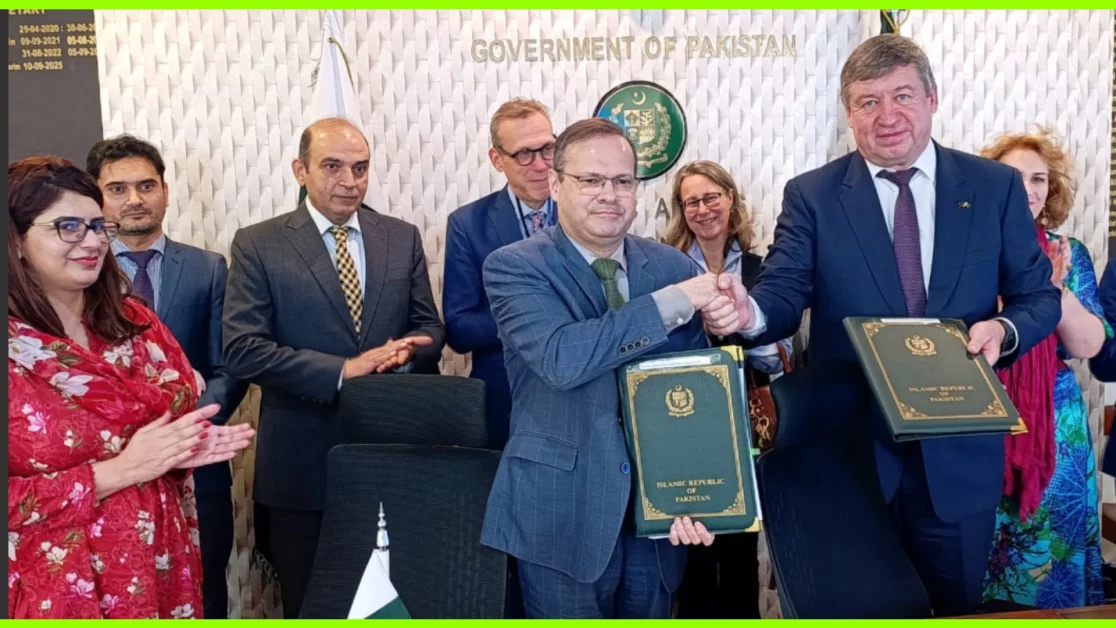
Pakistan and the EU have signed €65 million in financing agreements covering investment facilitation, energy resilience, rule of law and the business environment.
Pakistan and the European Union (EU) have signed financing agreements worth €65€ million, or approximately $75 million, to support investment, strengthen the rule of law and business environment, and improve energy and environmental resilience.
The agreements were signed by EU Ambassador to Pakistan Raimundas Karoblis and Economic Affairs Division (EAD) Secretary Muhammad Humair Karim on behalf of their respective sides.
The financing will support three programmes: Global Gateway Development Facilitation for Pakistan, Energy and Natural Environment Resilience in Khyber Pakhtunkhwa, and EU Support to the Rule of Law and Business Environment in Pakistan.
The programmes are being funded under the EU’s Multiannual Indicative Programme 2021-2027 and cover investment facilitation, renewable energy and access to justice.
The Global Gateway Development Facilitation for Pakistan programme will focus on investment management and financial enablement for environmental projects. It aims to support efforts to attract foreign investment by improving the tax system and strengthening the government’s long-term financial planning.
The second programme, Energy and Natural Environment Resilience in Khyber Pakhtunkhwa, will focus on expanding renewable energy in rural communities that are not connected to the electricity grid. It will also provide training aimed at attracting private investment and increasing private sector participation in the province’s energy sector.
The third programme will support the rule of law and business environment in Pakistan. It will seek to improve access to police, prosecution, courts and legal aid in Khyber Pakhtunkhwa and Balochistan.
The programme will also support Punjab and Sindh in expanding alternative and commercial dispute resolution mechanisms. The initiative is intended to strengthen the resolution of legal and commercial disputes and support greater interest from European and other companies in investing in the two provinces.
The Economic Affairs Division said EU development cooperation with Pakistan remains focused on economic development, climate resilience, governance and the rule of law, human rights and sustainable natural resource management.
EAD Secretary Muhammad Humair Karim welcomed the EU’s continued support, highlighting the relevance of the programmes to Pakistan’s objectives of attracting foreign investment, improving electricity access in off-grid rural communities and strengthening standards related to the rule of law and commercial dispute resolution.
EU Ambassador Raimundas Karoblis said the agreements reflected the EU’s commitment to supporting Pakistan’s economic development and investment ambitions through the Global Gateway initiative.
He also highlighted support for a more resilient energy sector and sustainable natural resource management in Khyber Pakhtunkhwa, alongside measures to improve access to justice and alternative dispute resolution.