

Visa, HBL Honor Pakistan’s Top Women Entrepreneurs
February 14, 2026
IMF Flags Inflation Risk in Tariff Plan
February 15, 2026
Pakistan’s telecom market is now competing on experience.
The latest Speedtest Connectivity Report covering July to December 2025 offers a data-driven snapshot of this evolution. Based on millions of consumer-initiated tests and quality of experience indicators, the results reveal a market where leadership is becoming more defined, but competition remains intense.
Jazz emerged as the strongest overall mobile performer during H2 2025. The operator recorded a median mobile download speed of 24.13 Mbps and an upload speed of 8.89 Mbps, alongside the lowest latency among competitors. More notably, it secured the highest overall Speedtest Connectivity Score of 59.83, a composite metric that blends speed, web browsing performance, and video streaming quality.
In everyday use, this translates into a smoother experience. Streaming rarely buffers, browsing remains responsive, and users stay connected with minimal interruptions. Jazz also recorded the highest Video Streaming Score of 74.41, reflecting its edge in one of Pakistan’s fastest-growing data consumption categories. Consumer sentiment reflected this performance, with Speedtest users rating Jazz the country’s top mobile provider at 3.48 out of 5.
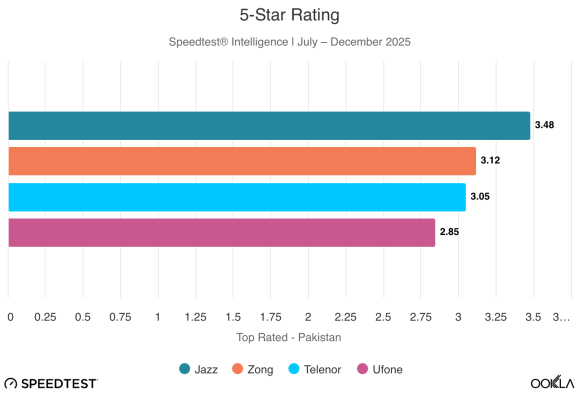
Image Source: Ookla
While Jazz led overall, Zong demonstrated strength in consistency and gaming performance. It recorded the highest network consistency, with 86.2% of samples meeting or exceeding baseline thresholds of 5 Mbps download and 1 Mbps upload. This level of stability is significant, especially outside urban centres, where reliability determines everyday usability. Zong also topped mobile gaming performance, scoring 68.46, an increasingly critical measure as Pakistan’s mobile-first youth continue to drive gaming adoption.
In the fixed broadband segment, Transworld emerged as Pakistan’s fastest ISP during the reporting period. It recorded median download speeds of 34.86 Mbps and uploads of 30.5 Mbps, reflecting the growing impact of fibre-backed infrastructure in urban centres. Meanwhile, PTCL Flash Fibre led the fixed broadband segment in gaming-specific performance, showing that speed is just one piece of the broader user experience.
Geographic performance trends further illustrate the evolving landscape. Among Pakistan’s most populous cities, Faisalabad led mobile download speeds at 24.13 Mbps, followed by Hyderabad and Multan. Rawalpindi recorded the lowest median mobile download speeds among major cities. For fixed broadband, Islamabad took the lead, reflecting stronger fibre penetration in the capital. Regionally, Punjab recorded the fastest median mobile download speed, while Azad Jammu and Kashmir lagged behind at 12.07 Mbps. Jazz emerged as the fastest provider across ten cities and four regions, showing both scale and reach.
Perhaps the most important shift reflected in this report is how performance is being measured. The Speedtest Connectivity Score moves beyond the traditional “fastest network” headline to emphasise real-world experience. Performance benchmarks now extend beyond peak speed to include consistency, latency, and the ability to handle streaming, gaming, and app-heavy use.
The H2 2025 results show a competitive yet differentiated market with Jazz leading the overall experience and speed, Zong excelling in consistency and gaming, Transworld pushing fixed broadband speeds higher, and PTCL Flash Fibre carving out a niche in gaming.
As Pakistan prepares for spectrum allocation and regulatory alignment, these results effectively establish a baseline. Operators who have built resilient 4G networks that balance speed, latency, and consistency are likely to transition more smoothly to 5G when it arrives. In many ways, the groundwork for next-generation connectivity is already being laid in how networks perform today.
Pakistan’s telecom sector continues to mature, and connectivity now supports digital participation across sectors. As performance expectations rise, leadership will increasingly be defined by sustained user experience delivered at scale. The competitive margins remain narrow, and as the market moves closer to 5G, experience will continue to shape the next phase of growth.