

NBP Partners With ISTIQEME To Expand Digital Payments
April 16, 2026
IMF Chief Praises Pakistan Reform Progress
April 17, 2026
Pakistan is no longer just a country of young people but a nation on the move. With a population of 257 million as of 2025, more Pakistanis than ever are looking beyond the border, not out of wanderlust, but necessity. Economic uncertainty, shrinking job prospects, and the simple desire for a dignified standard of living have turned migration from an option into a strategy.
Between 2023 and August 2025 alone over two million Pakistanis secured overseas employment in what can be defined as a quiet exodus that rarely makes headlines but is reshaping families, cities, and the future of the country itself. Yet amid this rush to leave, an important question is often left unasked: are we migrating smartly or just following familiar paths?
This guide looks beyond the usual destinations to unpack where Pakistanis are going today, how the real cost of living stacks up across countries, and speculate where future migrants might actually build better, more sustainable lives.
Disclaimer: Immigration policies and costs change frequently, especially within the current geopolitical landscape. Always verify current requirements from official government sources before making decisions. Cost of living data represents averages and actual expenses may vary based on lifestyle and specific locations.
Why Pakistanis Are Looking to Migrate in 2026
Economic Opportunities Abroad vs. Pakistan
The economic landscape in Pakistan has created a significant push factor for migration. With an average monthly salary in major cities ranging from PKR 47,000-50,000 ($168-$178 USD), many skilled professionals find it increasingly difficult to maintain a comfortable lifestyle amidst rising inflation. In contrast, destination countries offer salaries that are 5-20 times higher, with functional social security systems, healthcare, and educational opportunities.
Rising Migration Trends and Statistics
According to recent data from the Bureau of Emigration & Overseas Employment (BEOE):
-
-
-
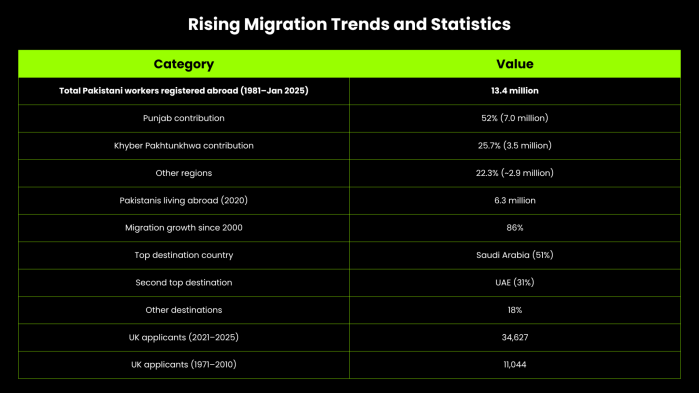
- Between 1981 and January 2025, over 13.4 million Pakistanis registered for employment abroad
- Punjab contributed 52% of this figure (7 million workers)
- Khyber Pakhtunkhwa accounted for 25.7% (3.5 million)
- In 2020, approximately 6.3 million Pakistani immigrants were residing abroad
- Migration has increased by 86% compared to 2000 levels
- Saudi Arabia remains the top destination (51% of all workers), followed by UAE (31%)
- Emerging destinations include the UK (34,627 applicants in 2021-2025, up from 11,044 in 1971-2010)
-
-
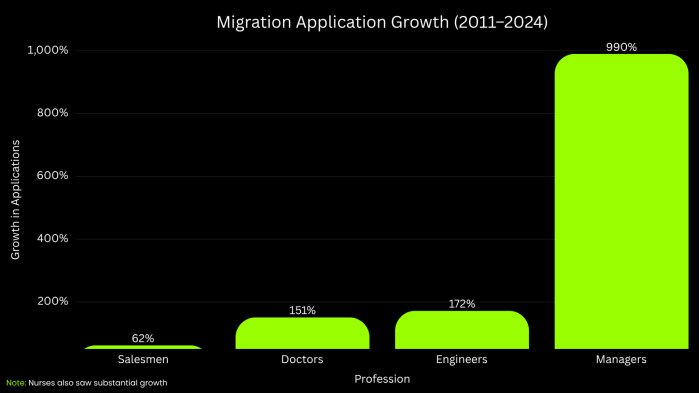
The trend extends beyond unskilled labor. Between 2011 and 2024, migration applications showed dramatic increases: salesmen (62%), doctors (151%), engineers (172%), managers (990%), and nurses also saw substantial growth.
Key Factors for Pakistanis Moving Abroad
1. What Makes a Country Ideal for Migration?
An ideal migration destination should offer:
-
-
-
- Clear pathways to permanent residency or citizenship
- Productive job markets with skills in demand
- Strong rule of law and security
- Quality healthcare and education systems
- Cultural acceptance and established Pakistani diaspora communities
- Family sponsorship opportunities
-
-
2. Visa Requirements and Immigration Pathways
Different countries offer various entry routess such as:
-
-
-
- Points-based systems: Canada, Australia (favors skilled workers)
- Employer sponsorship: USA, UK, UAE
- Investment-based: Turkey, Caribbean nations, Portugal
- Study-to-work pathways: Canada, Australia, UK, Germany
- Family reunification: Available in most Western countries
-
-
3. Cost of Living Considerations
Before migrating, understanding living costs is crucial. While salaries abroad are higher, expenses, particularly housing, can consume a significant portion of your income.
4. Job Market and Economic Opportunities
Each destination offers unique opportunities:
-
-
-
- Tech professionals: USA, Canada, Germany, Australia
- Healthcare workers: Canada, UK, Australia, Germany
- Construction/trades: UAE, Saudi Arabia, Australia
- Business/entrepreneurship: Canada, USA, UK, Turkey
-
-
Cost of Living Comparison: Pakistani Cities vs. International Destinations
Lahore, Islamabad, Karachi: Baseline Costs
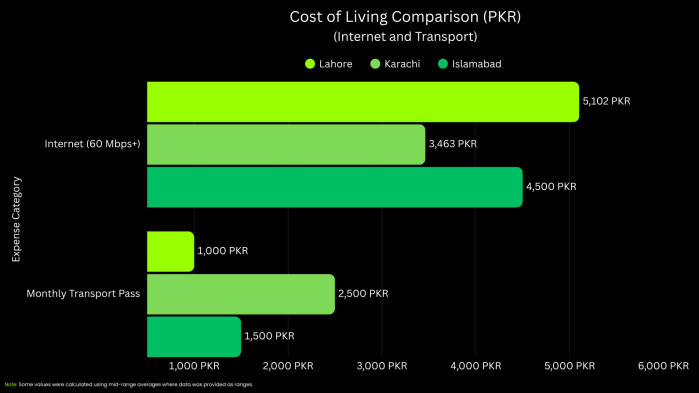
Understanding Pakistan’s cost of living provides essential context for international comparisons.
Monthly Living Costs in Pakistani Cities
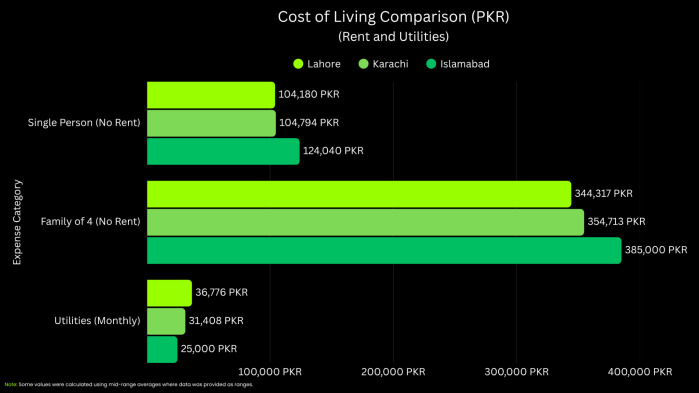
Key Insights: Islamabad is approximately 10-15% more expensive than Lahore and Karachi, primarily due to higher rent and overall living standards as the capital city. However, salaries are also marginally higher, and the city offers better infrastructure, cleaner environment, and lower pollution levels.
Key Grocery Prices (Pakistan)
Note: Grocery prices across all three cities remain relatively similar, with Islamabad being marginally higher (5-10%) but offering better quality produce and more variety in supermarkets.
International Destinations: Side-by-Side Comparison
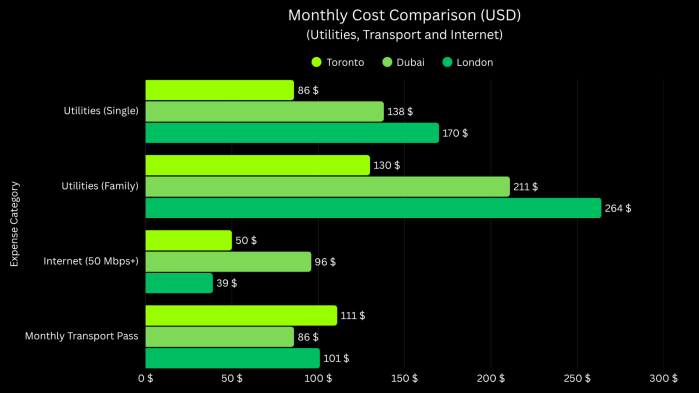
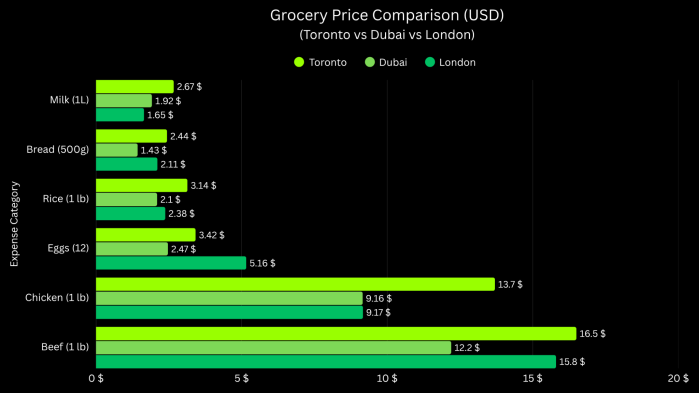
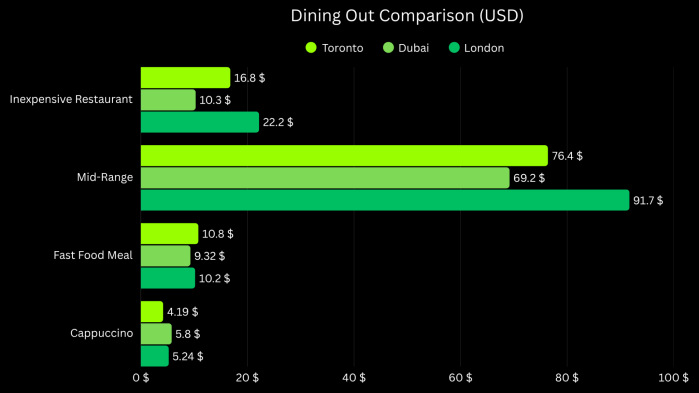
Now let’s compare these costs with three major migration destinations: Toronto (Canada), Dubai (UAE), and London (UK).
Complete Monthly Cost Comparison
Comparative Grocery Prices
Dining Out Comparison
Salary Expectations and Purchasing Power
The critical factor isn’t just cost but purchasing power, i.e. how far your salary goes.
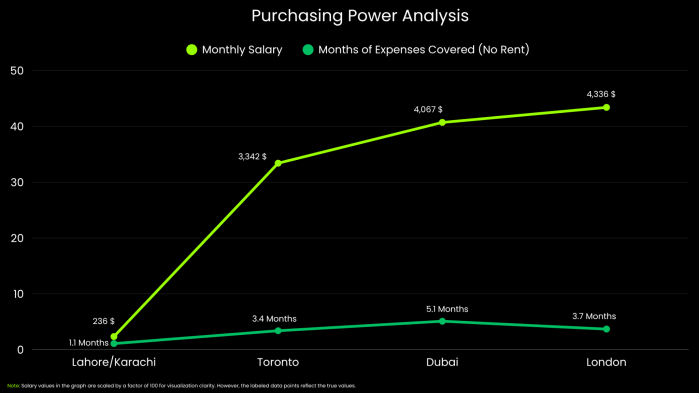
Purchasing Power Analysis:
-
-
-
- Lahore/Karachi: Average salary PKR 47,000-80,000 ($168-285) covers 1.0-1.2 months of expenses (just barely) without rent.
- Toronto: Salary $3,342 covers 3.4 months without rent.
- Dubai: Salary $4,067 covers 5.1 months without rent.
- London: Salary $4,336 covers 3.7 months without rent.
-
-
Key Insight: While Dubai has higher nominal costs in some areas, the tax-free salary structure significantly enhances purchasing power. London offers the highest salary but also the highest living costs. Toronto provides balanced opportunities with a clear path to permanent residency.
Note that this analysis excludes rent as it depends on residential type, location size and number of residents.
Top Migration Destinations for Pakistanis
Canada
Canada consistently ranks as the top choice for Pakistani immigrants seeking permanent settlement.
Express Entry Program
Canada’s Express Entry system manages applications for three federal immigration programs through a points-based Comprehensive Ranking System (CRS):
Key Requirements:
-
-
-
- Language proficiency (IELTS/CELPIP for English; TEF/TCF for French)
- Educational Credential Assessment (ECA)
- Minimum 1 year skilled work experience
- Points awarded for age (25-35 optimal), education, experience, and adaptability
-
-
Current CRS cutoff scores: 470-540 (fluctuates based on draw type)
Processing time: 6-12 months
Provincial Nominee Programs (PNPs)
Several provinces offer easier pathways:
-
-
-
- Ontario Immigrant Nominee Program (OINP): Strong tech sector demand
- British Columbia PNP: Healthcare and tech focus
- Alberta Immigrant Nominee Program: Trades and agriculture
- Saskatchewan: Lower CRS requirements
- Atlantic Immigration Program: Faster processing, lower requirements
-
-
Cost of Living in Major Canadian Cities
Beyond Toronto, other cities offer lower costs:
-
-
-
- Montreal: $1,903/month (single person with rent)
- Calgary: $2,079/month
- Ottawa: $2,096/month
- Edmonton: $1,823/month
- Halifax: $2,088/month
-
-
Job Opportunities for Pakistanis
High-demand sectors include:
-
-
-
- Information Technology: Software developers, data analysts, cybersecurity
- Healthcare: Nurses, PSWs, doctors (after licensing)
- Engineering: Civil, mechanical, electrical engineers
- Skilled Trades: Electricians, plumbers, welders
- Business & Finance: Accountants, financial analysts
-
-
Average salaries (CAD):
-
-
-
- Software Developer: $70,000-$95,000
- Registered Nurse: $65,000-$85,000
- Civil Engineer: $65,000-$90,000
- Electrician: $55,000-$75,000
-
-
Healthcare and Education System
Canada offers universal healthcare (covered by provincial plans after waiting period) and excellent public education (free K-12, subsidized post-secondary).
Path to Permanent Residency and Citizenship
-
-
-
- PR through Express Entry: Immediate upon approval
- Citizenship eligibility: After 3 years of PR status (physically present in Canada for 1,095 days in 5 years)
- Family sponsorship: PRs can sponsor spouses, children, parents, and grandparents
-
-
Australia
Australia actively recruits skilled professionals from Pakistan, particularly in healthcare, engineering, and IT.
Skilled Migration Program (Subclass 189, 190)
Subclass 189 (Skilled Independent Visa):
-
-
-
- Points-tested (minimum 65 points)
- No state sponsorship required
- Live and work anywhere in Australia
- Permanent residency from day one
-
-
Subclass 190 (Skilled Nominated Visa):
-
-
-
- Requires state nomination (+5 points)
- Must live in nominating state for 2 years
- Wider occupation list
- Easier to qualify than 189
-
-
Popular state nominations:
-
-
-
- Victoria: Healthcare, IT, engineering
- New South Wales: Broad occupations
- Queensland: Regional opportunities
- South Australia: Lower points threshold
-
-
Cost of Living Comparison: Sydney, Melbourne, Adelaide
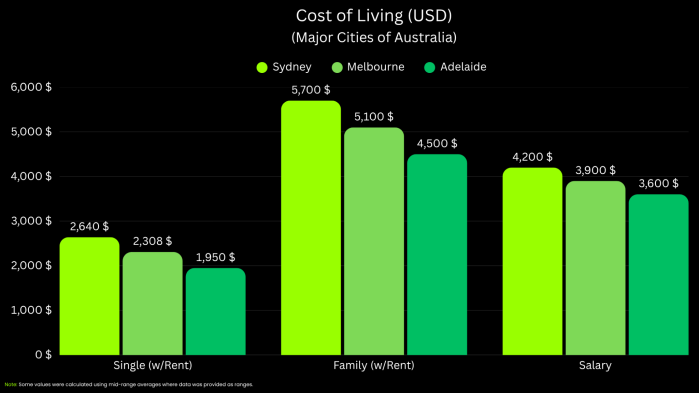
Adelaide offers the most affordable lifestyle while still providing strong job opportunities.
Employment Sectors Hiring Pakistanis
In-demand occupations:
-
-
-
- Registered Nurses
- Software Engineers
- Civil Engineers
- Accountants
- Construction Project Managers
- Electricians and Plumbers
- Secondary School Teachers
- Chefs
-
-
Average salaries (AUD):
-
-
-
- Registered Nurse: $70,000-$90,000
- Software Engineer: $85,000-$120,000
- Civil Engineer: $75,000-$100,000
-
-
Quality of Life and Pakistani Diaspora Community
Australia boasts excellent quality of life with:
-
-
-
- Strong work-life balance
- World-class healthcare (Medicare)
- Top-tier education system
- Safe, multicultural cities
- Established Pakistani community (especially in Sydney and Melbourne)
-
-
United Arab Emirates
The UAE, particularly Dubai and Abu Dhabi, has been a traditional destination for Pakistani workers since the 1970s oil boom.
Golden Visa Program for Investors and Professionals
Introduced in 2019, the Golden Visa offers 5-10 year renewable residency:
Eligibility categories:
-
-
-
- Investors: AED 2 million+ property investment
- Entrepreneurs with established projects
- Specialized talents (doctors, scientists, artists)
- Outstanding students with 3.75+ GPA
-
-
Benefits:
-
-
-
- No sponsor required
- Can sponsor family members
- 6-month grace period after visa expiry
- Multiple entry visa
-
-
Employment Visa Pathways
Standard employment visas require:
-
-
-
- Job offer from UAE employer
- Employer sponsorship
- Medical fitness test
- Police clearance
-
-
Validity: 2 years (renewable)
Living Costs in Dubai vs. Abu Dhabi
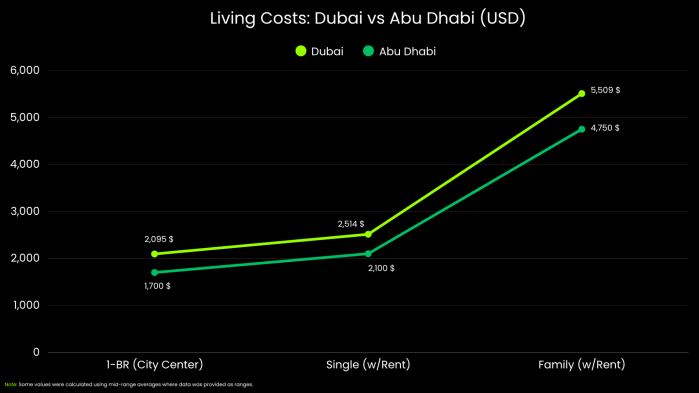
Abu Dhabi is 15-20% cheaper than Dubai while offering similar opportunities.
Tax-Free Salaries and Benefits
The UAE’s biggest advantage: 0% personal income tax
Common salary packages include:
-
-
-
- Basic salary
- Housing allowance (25-40% of basic)
- Transportation allowance
- Annual flight tickets home
- Health insurance
- Children’s education allowance (management positions)
-
-
Average monthly salaries (AED):
-
-
-
- IT Professional: 12,000-25,000 ($3,265-$6,805)
- Engineer: 10,000-20,000 ($2,720-$5,445)
- Accountant: 8,000-15,000 ($2,177-$4,083)
- Construction Worker: 2,000-4,000 ($545-$1,089)
-
-
Pakistani Community and Cultural Integration
The UAE hosts over 1.5 million Pakistanis, making integration seamless:
-
-
-
- Pakistani restaurants, grocery stores, and cultural centers
- Cricket and sports facilities
- Islamic environment
- Urdu widely understood
-
-
Limitations: No path to permanent residency or citizenship (except Golden Visa holders).
United Kingdom
The UK has historical ties with Pakistan, with a Pakistani diaspora of 1.6 million—one of the largest outside South Asia.
Skilled Worker Visa Requirements
Replaced the Tier 2 visa in 2021:
Requirements:
-
-
-
- Job offer from licensed UK sponsor
- Role on skilled occupation list
- Minimum salary: £38,700 or occupation rate (whichever is higher)
- English language proficiency (IELTS B1)
- Certificate of Sponsorship (CoS)
-
-
Priority occupations: Healthcare, IT, engineering, education
Innovator and Student Visa Options
Innovator Founder Visa:
-
-
-
- For entrepreneurs with innovative, viable, scalable business ideas
- Requires endorsement from approved body
- £50,000 investment minimum
- Path to settlement after 3 years
-
-
Student Visa:
-
-
-
- Popular pathway for Pakistanis
- Study at UK university
- Post-study work rights: 2 years (3 years for PhD)
- Can switch to Skilled Worker Visa
-
-
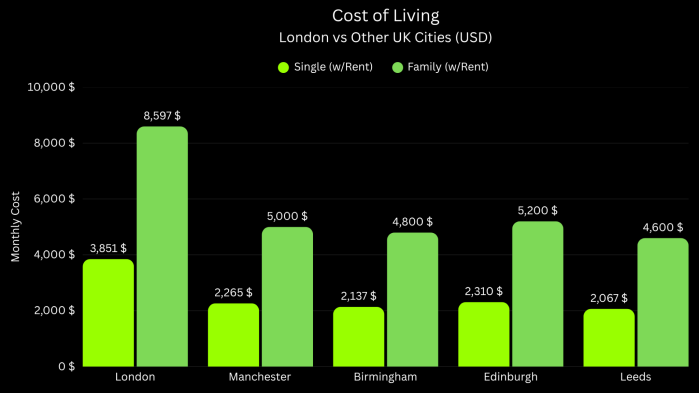
Cost of Living: London vs. Other UK Cities
London is significantly more expensive:
Job Opportunities in Finance, Healthcare, and IT
High-demand sectors:
-
-
-
- Finance: London is a global financial hub
- Healthcare: NHS constantly recruiting nurses and doctors
- IT: Software developers, cybersecurity specialists
- Engineering: Civil, mechanical, electrical
-
-
Average salaries (GBP):
-
-
-
- Software Developer: £40,000-£65,000
- Registered Nurse: £28,000-£44,000
- Civil Engineer: £35,000-£55,000
- Financial Analyst: £35,000-£60,000
-
-
Pakistani Community Support (1.6 Million Strong)
The UK’s Pakistani community offers extensive support networks:
-
-
-
- Established in major cities (Birmingham, Bradford, Manchester, London)
- Community organizations and mosques
- Pakistani businesses and restaurants
- Cricket clubs and cultural events
-
-
Germany
Germany is emerging as an attractive destination due to labor shortages and straightforward pathways for skilled workers.
EU Blue Card for Highly Skilled Workers
The EU Blue Card offers:
-
-
-
- Work and residence permit for qualified professionals
- Valid across EU (with restrictions)
- Minimum gross annual salary: €45,300 (2025; lower for shortage occupations)
- University degree required
-
-
Benefits:
-
-
-
- Bring family members
- PR eligibility after 21-33 months
- Pathway to German citizenship
-
-
Job Seeker Visa Explained
Germany offers a unique 6-month Job Seeker Visa:
Requirements:
-
-
-
- Recognized university degree
- Proof of financial means (€6,024+ for 6 months)
- Health insurance
- Accommodation proof
-
-
Process: Visit Germany, attend interviews, secure job, convert to work permit.
Tuition-Free Education Opportunities
Germany’s biggest advantage for families: free public university education (nominal semester fees of €300-400).
Study pathways:
-
-
-
- Bachelor’s and Master’s programs
- English-taught programs available
- Student visa with 120 full days/240 half days work rights
- 18-month post-study job search visa
-
-
Cost of Living and Job Market Analysis
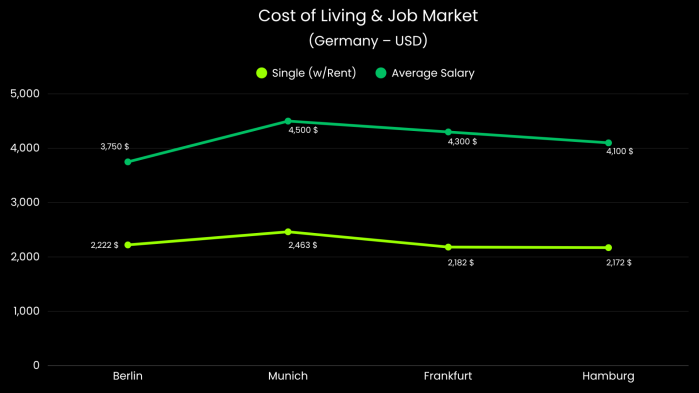
In-demand sectors:
-
-
-
- IT and software development
- Engineering (mechanical, electrical, automotive)
- Healthcare (nurses, doctors)
- Skilled trades
-
-
Language Requirements and Integration Support
German language:
-
-
-
- B1 level for most work visas
- EU Blue Card holders can use English initially
- Integration courses (free/subsidized) available
- Citizenship requires B1 level
-
-
Support for immigrants:
-
-
-
- Language courses
- Recognition of foreign qualifications
- Integration assistance programs
-
-
Turkey
Turkey offers the fastest citizenship route for Pakistanis willing to invest.
Citizenship by Investment Program ($400k Requirement)
Turkey’s program is one of the most accessible:
Investment options:
-
-
-
- Real estate: Buy property worth $400,000+ (hold for 3 years)
- Bank deposit: $500,000 (hold for 3 years)
- Business investment: $500,000 + employ 50 Turkish citizens
-
-
Timeline: 3-6 months to citizenship
Benefits:
-
-
-
- Visa-free travel to 110+ countries
- No residency requirement
- Family inclusion
- Keep your original citizenship
-
-
Cultural Similarities for Pakistani Nationals
Turkey appeals to Pakistanis due to:
-
-
-
- Islamic culture
- Historical ties
- Similar cuisine and lifestyle
- Growing Pakistani community
- Favorable visa policies
-
-
Real Estate Investment Opportunities
Turkish property market offers:
-
-
-
- Modern apartments in Istanbul, Ankara, Antalya
- Prices: $1,000-$2,500/sqm (varies by location)
- Rental income potential: 5-8% annually
- Property management services available
-
-
Cost of Living in Istanbul and Ankara
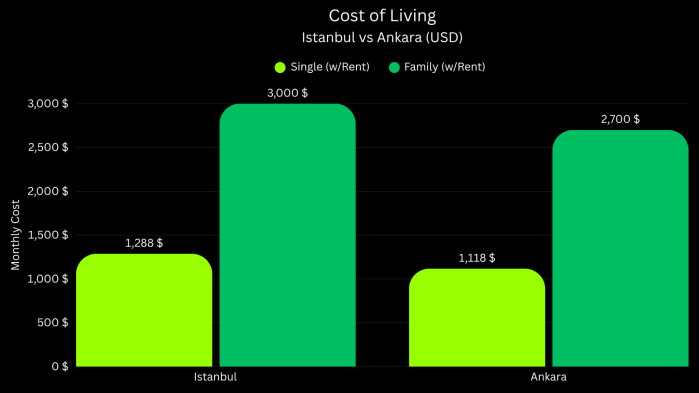
Key expenses (Istanbul):
-
-
-
- 1-BR (City Center): $600-800
- Utilities: $80-120
- Monthly transport: $40
- Meals: $5-15
-
-
Turkey is significantly more affordable than Western destinations while offering European lifestyle benefits.
Where Should Pakistanis Migrate? Data-Driven Recommendations
Best for Skilled Workers: Canada, Australia, Germany
Recommendation: If you have education, work experience, and strong English skills, prioritize these three.
Why:
-
-
-
- Clear points-based systems
- Permanent residency pathways
- High salaries and benefits
- Quality healthcare and education
- Path to citizenship
- Strong rule of law
-
-
Action steps:
-
-
-
- Take IELTS/language tests
- Get educational credentials assessed
- Calculate points for Express Entry/SkillSelect
- Apply for provincial nominations (Canada) or state sponsorship (Australia)
- Consider Germany’s Job Seeker Visa for EU opportunities
-
-
Best for Fast Citizenship: Turkey, Caribbean Countries
Recommendation: If you have capital ($150,000-$400,000) and want citizenship quickly without relocation requirements.
Caribbean options:
-
-
-
- Dominica: $100,000 donation (single applicant)
- Kitts & Nevis: $150,000 donation
- Grenada: $150,000 donation
- Antigua & Barbuda: $100,000 donation
-
-
Turkey: $400,000 real estate investment
Benefits:
-
-
-
- Fast processing (3-6 months)
- Visa-free travel to 110-150+ countries
- No residency requirements
- Business opportunities
- Tax advantages
-
-
Best for Tax Benefits: UAE, Singapore
Recommendation: If maximizing savings is your priority and you’re comfortable with temporary residency.
UAE advantages:
-
-
-
- 0% personal income tax
- High salaries
- Modern infrastructure
- Safe environment
- No wealth or inheritance tax
-
-
Singapore advantages:
-
-
-
- Low tax rates (progressive, max 22%)
- High salaries
- World-class infrastructure
- Strategic Asia location
- Strong rule of law
-
-
Tradeoff: No easy path to citizenship; focus on earning and saving.
Best for Families: Canada, Australia, UK
Recommendation: If you’re migrating with spouse and children, prioritize these destinations.
Why:
-
-
-
- Quality public education
- Universal/comprehensive healthcare
- Safe environments
- Family-friendly policies
- Childcare support
- Parks and recreational facilities
- Path to citizenship for children
-
-
Canada specifically:
-
-
-
- Canada Child Benefit (tax-free monthly payments)
- Subsidized childcare
- Free public schools
- Subsidized university education (for PRs)
-
-
Best for Affordability: Malaysia, Turkey
Recommendation: If you’re budget-conscious or seeking a lower-cost lifestyle while working remotely.
Malaysia:
-
-
-
- Monthly costs: $1,200-1,500 (single with rent)
- MM2H visa for retirees/remote workers
- English widely spoken
- Halal-friendly environment
-
-
Turkey:
-
-
-
- Monthly costs: $1,100-1,300 (single with rent)
- Growing digital nomad scene
- Strategic Europe-Asia location
- Rich cultural experience
-
-
Step-by-Step: How to Start Your Migration Journey
1. Assessing Your Skills and Qualifications
Create an inventory:
-
-
-
- Education level (degrees, diplomas, certifications)
- Work experience (years, industries, job titles)
- Language proficiency (take IELTS/CELPIP/TEF)
- Financial resources (savings, assets)
- Age (younger is generally better for points systems)
- Family situation (spouse, dependents)
-
-
Tool: Use Canada’s CRS Calculator or Australia’s Points Calculator to estimate eligibility.
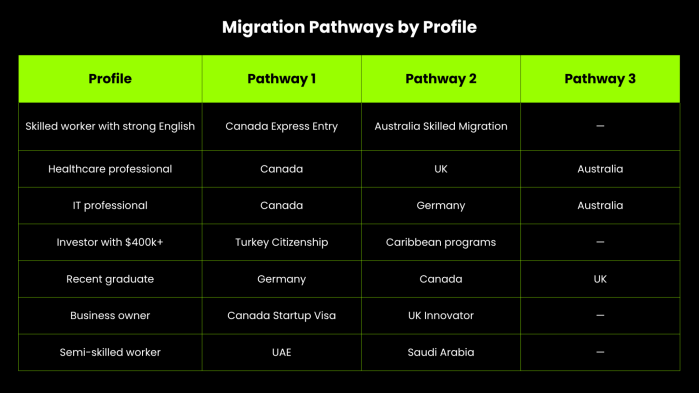
2. Choosing the Right Immigration Pathway
Match your profile to the best pathway:
3. Document Preparation and Requirements
Essential documents:
-
-
-
- Valid passport (6+ months validity)
- Educational transcripts and degrees
- Educational Credential Assessment (ECA) for Canada/Australia
- Work reference letters (detailed job descriptions)
- Language test results (IELTS, CELPIP, TEF, etc.)
- Police clearance certificates
- Medical examinations
- Proof of funds (bank statements)
- Marriage certificate, children’s birth certificates
- Resume/CV
-
-
Pro tip: Start gathering documents early; some take weeks to obtain.
4. Working with Immigration Consultants
When to hire a consultant:
-
-
-
- Complex cases (previous visa refusals, inadmissibility issues)
- Business immigration pathways
- Investment programs
- When unsure about eligibility
- For peace of mind and expert guidance
-
-
What to look for:
-
-
-
- Licensed/regulated consultant (RCIC for Canada, MARA for Australia)
- Transparent fees
- Client reviews and success rates
- Clear communication
- No guaranteed approvals (red flag)
-
-
Red flags:
-
-
-
- Unrealistic promises
- Requests for payment to government officials
- Pressure tactics
- No written agreement
-
-
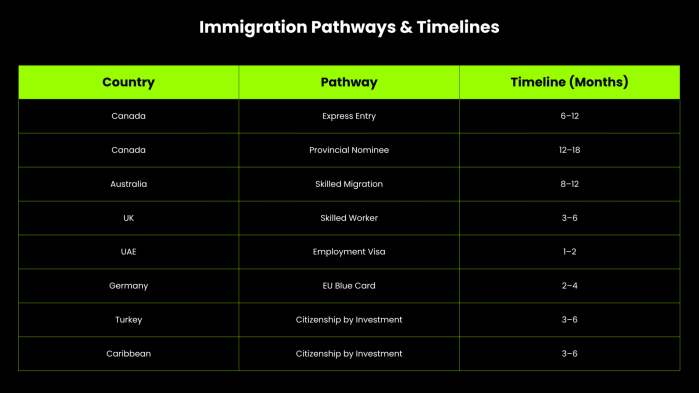
5. Timeline Expectations by Country
Common Challenges Pakistanis Face When Migrating
Language Barriers and Solutions
Challenge: IELTS/language test anxiety; communicating effectively in English/French/German.
Solutions:
-
-
-
- Enroll in English courses (British Council, local institutes)
- Practice with native speakers (language exchange apps)
- Watch English media daily
- Take mock tests
- Consider PTE Academic as IELTS alternative
- For Germany/France, start language learning early (A1-B1 takes 6-12 months)
-
-
Recognition of Pakistani Degrees Abroad
Challenge: Foreign authorities may not recognize Pakistani qualifications.
Solutions:
-
-
-
- Canada: Get ECA from WES, IQAS, or other designated organizations
- Australia: Skills assessment through relevant assessing authority
- UK: NARIC statement of comparability
- Germany: Anabin database or ZAB recognition
- Consider bridging programs for regulated professions (nursing, teaching, engineering)
-
-
Pro tip: Start credential assessment early; it can take 2-4 months.
Cultural Adaptation Tips
Challenge: Adjusting to new cultural norms, weather, social systems.
Solutions:
-
-
-
- Join Pakistani community groups (Facebook, WhatsApp, local organizations)
- Participate in cultural orientation programs
- Stay connected with family via technology
- Be open-minded and curious
- Learn local customs and etiquette
- Find mosques and halal food options early
- Give yourself time (full adaptation takes 1-2 years)
-
-
Financial Planning for Migration
Challenge: Managing costs of migration process, initial settlement, and maintaining finances in Pakistan.
Budget breakdown (estimated):
| Expense | Cost Range |
| IELTS test | $200-250 |
| Educational credential assessment | $200-300 |
| Medical examinations | $300-500 (per person) |
| Police clearance | $50-100 |
| Application fees | $500-$2,000 (varies by country) |
| Legal/consultant fees | $2,000-$5,000 |
| Flight tickets | $800-$1,500 (per person) |
| Initial settlement funds | $10,000-$20,000 |
| Total | $15,000-$30,000+ |
Financial planning tips:
- Save 6 months’ living expenses for destination country
- Maintain Pakistani bank account for remittances
- Research banking options in destination (some banks offer newcomer programs)
- Understand tax implications (Canada/Australia PRs taxed on worldwide income)
- Consider money transfer services (Wise, Remitly) to send money home
Future Migration Trends: What to Expect in 2026
Changing Immigration Policies
Key trends to watch:
- Canada: Reducing permanent resident targets from 500,000+ annually to more sustainable levels; increased focus on French-speaking immigrants and healthcare workers
- Australia: Maintaining skilled migration levels but tightening student visa rules; focus on regional migration
- UK: Post-Brexit immigration system maturing; potential changes to salary thresholds and shortage occupation list
- USA: Potential reform of green card process; increased scrutiny on H-1B visas
- Europe: Germany and other EU countries easing rules for skilled workers due to demographic challenges
- UAE: Expanding Golden Visa categories; more freelance and remote work options
Emerging Destinations for Pakistanis
Rising stars in 2025-2026:
- Poland: EU membership, growing economy, lower costs than Western Europe, tech sector expansion
- Portugal: Golden Visa program (minimum €250,000 investment), mild climate, affordable living
- Romania: Emerging tech hub, low cost of living, pathway to EU citizenship
- Malaysia: MM2H visa program, Muslim-friendly environment, English widely spoken, affordable
- Oman: Similar to UAE but more relaxed, growing economy, lower costs
Why emerging destinations matter:
-
-
-
- Less competition in application processes
- Lower investment thresholds
- Affordable living costs
- Growing job markets
- Gateway to larger regions (EU, GCC, ASEAN)
-
-
Remote Work Visa Opportunities
The pandemic accelerated remote work visa programs—perfect for digital professionals:
Countries offering digital nomad/remote work visas:
-
-
-
- Portugal: D7 Passive Income Visa or Digital Nomad Visa (€3,040/month income)
- Spain: Digital Nomad Visa (€2,646/month minimum)
- Dubai: Virtual Working Program (1 year, renewable)
- Greece: Digital Nomad Visa (€3,500/month)
- Croatia: Digital Nomad Visa (€2,870/month)
- Malta: Nomad Residence Permit (€2,700/month)
-
-
Benefits:
-
-
-
- Work remotely for foreign companies
- Live in desirable locations
- Lower tax rates in some jurisdictions
- Path to permanent residency (in some cases)
- Family inclusion
-
-
Ideal for: IT professionals, digital marketers, designers, writers, consultants
Summary of Key Considerations
Migration is a life-changing decision that requires careful planning and realistic expectations. Here are the core takeaways:
Financial Reality: While salaries abroad are higher, so are living costs. Calculate net savings potential, not just gross income. Dubai offers tax-free income; Canada and Australia provide higher absolute salaries with path to citizenship.
Permanent vs. Temporary: Decide whether you want temporary work (UAE, Saudi Arabia) or permanent settlement (Canada, Australia, UK). Your age, family situation, and long-term goals should guide this choice.
Skill Alignment: Your qualifications matter immensely. Skilled workers with strong English and in-demand expertise have multiple options. Semi-skilled workers may find better opportunities in the Gulf.
Investment Capital: If you have $150,000-$400,000+, citizenship-by-investment programs (Turkey, Caribbean) offer the fastest routes to second passports.
Family Priorities: If migrating with family, prioritize destinations with strong education and healthcare systems (Canada, Australia, UK, Germany).
Timeline: Express Entry to Canada takes 6-12 months; employment visas to UAE take 1-2 months; citizenship by investment takes 3-6 months. Plan accordingly.
Final Recommendations by Profile Type
For IT/Tech Professionals: 1st choice: Canada (Express Entry) 2nd choice: Germany (EU Blue Card) 3rd choice: Australia (Skilled Migration)
For Healthcare Workers: 1st choice: Canada (Provincial Nominee) 2nd choice: UK (NHS Skilled Worker) 3rd choice: Australia (State Sponsorship)
For Investors/Business Owners: 1st choice: Canada (Startup Visa) 2nd choice: Turkey (Citizenship by Investment) 3rd choice: UK (Innovator Founder)
For Recent Graduates: 1st choice: Germany (Study + Job Seeker) 2nd choice: Canada (Study Permit + PGWP) 3rd choice: Australia (Student + Post-Study Work)
For Semi-Skilled Workers: 1st choice: UAE (Employment Visa) 2nd choice: Saudi Arabia (Work Permit) 3rd choice: Australia (Trades Pathway)
For Families Seeking Quick Citizenship: 1st choice: Turkey ($400k real estate) 2nd choice: Dominica ($100k donation) 3rd choice: St. Kitts & Nevis ($150k donation)
For Maximum Savings (Tax Benefits): 1st choice: UAE (0% tax) 2nd choice: Singapore (low tax) 3rd choice: Saudi Arabia (0% tax)
Next Steps and Resources
Immediate Actions:
-
-
-
- Take a language test: Book IELTS/CELPIP within the next month
- Get credentials assessed: Start WES or equivalent evaluation
- Calculate points: Use official calculators for Express Entry/SkillSelect
- Build your profile: Update LinkedIn, gather reference letters
- Save aggressively: Target $20,000+ for migration expenses and settlement
-
-
Official Resources:
-
-
-
- Canada: www.canada.ca/en/immigration-refugees-citizenship.html
- Australia: www.homeaffairs.gov.au
- UK: www.gov.uk/browse/visas-immigration
- Germany: www.make-it-in-germany.com
- UAE: www.gdrfad.gov.ae
-
-
Community Support:
-
-
-
- Join Pakistani expat groups on Facebook for each destination
- Connect with Licensed Immigration Consultants (verify credentials)
- Follow immigration law updates (policies change frequently)
- Network with Pakistanis already living abroad
-
-
Conclusion
Migration is not easy, but millions of Pakistanis have successfully built new lives abroad. The key is thorough research, honest self-assessment, proper planning, and persistence. Whether you choose Canada’s welcoming multiculturalism, Dubai’s tax-free prosperity, the UK’s historical ties, or Germany’s emerging opportunities, success depends on preparation and adaptability.
Start today. Research your options, assess your eligibility, and take the first step toward your new future. The world is more accessible than ever and you need only seize the opportunity.
FAQs
Which country is easiest to immigrate to from Pakistan?
For skilled workers with strong English: Canada (Express Entry) or Australia (Skilled Migration)
For quick citizenship with investment: Turkey ($400k) or Caribbean countries ($100k+)
For immediate employment: UAE or Saudi Arabia (employer sponsorship)
For students: Germany (tuition-free universities) or Canada (post-study work rights)
Easiest based on processing time: UAE (1-2 months) or Turkey citizenship (3-6 months)
Easiest based on requirements: UAE employment visa (only requires job offer) or Malaysia MM2H (passive income visa)
How much does it cost to migrate from Pakistan?
Cost breakdown by pathway:
Express Entry to Canada:
-
-
-
- IELTS: $250
- Educational Credential Assessment: $250
- Medical: $500 (per person)
- Application fees: $1,500 (principal applicant)
- Settlement funds: $15,000+ (family of 3)
- Consultant fees (optional): $3,000-5,000
- Total: $20,000-$25,000
-
-
Australia Skilled Migration:
-
-
-
- IELTS: $250
- Skills assessment: $300-500
- Medical: $500 (per person)
- Application fees: $4,640 AUD (~$3,000 USD)
- Settlement funds: $15,000+
- Total: $20,000-$28,000
-
-
UAE Employment Visa:
-
-
-
- Medical: $100
- Visa processing: $300-500
- Flight: $600
- Initial settlement: $2,000-3,000
- Total: $3,000-$5,000
-
-
Turkey Citizenship by Investment:
-
-
-
- Property: $400,000
- Legal fees: $10,000-15,000
- Processing: $5,000
- Total: $415,000-$420,000
-
-
UK Skilled Worker Visa:
-
-
-
- IELTS: $250
- Health surcharge: $624/year
- Visa application: $1,048
- Medical: $500
- Flights and settlement: $5,000
- Total: $8,000-$10,000 (+ £38,700 salary requirement)
-
-
Which countries don’t require IELTS?
Countries/pathways that may waive IELTS:
-
-
-
- Turkey: No English requirement for citizenship by investment
- UAE: No IELTS for employment visa (employer determines English needs)
- Saudi Arabia: No formal English test for most employment visas
- Caribbean countries: No English requirement for citizenship by investment
- Malaysia: No IELTS for MM2H visa
- Some Canadian provincial programs: If you have Canadian education or work experience
- Germany: Can use EU Blue Card with English if job doesn’t require German (though B1 German helpful)
-
-
Important notes:
-
-
-
- While not mandatory, English proficiency dramatically improves job prospects
- Most skilled migration pathways (Canada Express Entry, Australia Points Test) REQUIRE language tests
- UK Skilled Worker Visa requires English proficiency proof (IELTS or equivalent)
- Professional licensing bodies often require language tests even if visa doesn’t
-
-
IELTS alternatives:
-
-
-
- PTE Academic: Accepted by Australia, Canada, UK
- CELPIP: Canada only, easier for some test-takers
- TOEFL: Accepted by some programs
- Duolingo English Test: Accepted by some institutions (mainly study permits)
-
-
Bottom line: If your goal is skilled migration to top destinations (Canada, Australia, UK), you cannot avoid English testing. However, investment-based programs and Gulf employment visas don’t require formal English tests.
Sources:
-
-
-
- Data sourced from Numbeo.com (February 2026)
- org (January 2026 update)
- Bureau of Emigration & Overseas Employment (BEOE), Pakistan
- Official immigration websites of Canada, Australia, UK, UAE, Germany, and Turkey
- Lalani & Associates migration trends report (2025)
-
-