
Pakistan Hosts 12 Nations for Poverty Summit
October 12, 2026
AI can now draft a headline, transcribe an interview and summarize a long report. The harder question is who answers for the result. The Associated Press has updated its newsroom standards for artificial intelligence, setting out where the technology can help journalists and where human responsibility has to stay in place. The update speaks to a question that many news organizations now face: how can AI make newsroom work more efficient without weakening the standards that journalism depends on?
That question is easy to ask and harder to answer in practice. A policy that is too loose invites errors that readers will eventually notice. A policy that is too tight may be ignored by staff who are already using these tools on their own. AP’s approach is worth examining because it tries to draw a specific line, and because the way it draws that line, and the places where it leaves room for interpretation, say a good deal about the choices other newsrooms will have to make.
What the Standards Allow
Under the guidance, journalists may use AI for a defined set of tasks. These include early-stage research, document summarization, transcription, translation, headline suggestions, story summaries, shot lists, grammar and spelling checks, and search optimization. The standards also add guidance on AI coding assistants used in software development, which reflects the fact that a news organization is also a technology operation with its own engineers, and that the same questions about review and accountability apply to code that supports the news report. In every case, AI output must be reviewed and edited by an AP journalist before anything is published.
The list is narrow and practical. It does not describe AI writing the news. It describes AI handling the material that surrounds the news: recordings, foreign-language documents, long filings, metadata and copy that needs tidying. Each item is a task where a machine can save time and where a human can check the result against the original.
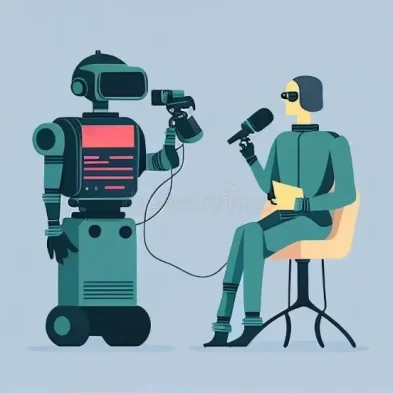
Image Credits: Elena Dyrda Via Dreamstime
Why the Line Falls Where It Does
None of the approved tasks, taken alone, decides whether a report is accurate or newsworthy. A tool can organize information or produce a first draft. Deciding what is relevant, checking sources and judging whether a claim can be published remain journalistic responsibilities, and AP says plainly that AI does not replace reporting, sourcing, editorial judgment or verification.
Consider how each permitted task still depends on a person. A transcript is useful, but someone has to decide which quote belongs in the story and whether it was said in the context the story implies. A translation saves hours, but someone has to judge whether the translated document is reliable in the first place. A summary of a hundred-page report is a convenient starting point, yet what a summary leaves out is often the story. In each case the tool handles the volume and the journalist handles the judgment. That division is the logic of the whole policy.

Image Credits: Sergy Tinyakov Via Dreamstime
The Practical Case
There is a straightforward practical argument for this approach. Journalists spend a good deal of time on work that supports reporting without being reporting itself: transcribing recordings, translating material, reading long documents to find the few paragraphs that matter. If AI takes on part of that load, more of a working day can go to interviews, verification and developing stories. Seen this way, AI is another newsroom tool, closer to a search engine or a spreadsheet than to a substitute for the person doing the work.
AP names accuracy, fairness and speed as the values that guide its news report. Speed is the one AI can improve most obviously, which is why the review requirement matters: it keeps the other two from being traded away. Wire services in particular work under constant time pressure, and the temptation to publish quickly is built into the job.
A review rule also depends on how it is carried out. If AI saves time, some of that time has to go back into checking its output, because summaries and translations can contain errors that read smoothly. A fabricated detail in fluent prose is harder to catch than a typing mistake. A rule that exists on paper but is rushed in practice offers little protection, so the real measure of the policy will be whether editors have the time and the habit to check what the tools produce.
Where the Limits Sit
The standards also show why limits matter. AP continues to prohibit generative AI from creating, altering or enhancing news photography. The reasoning is easy to follow. A photograph is treated by audiences as evidence that something happened, and once an image can be altered or invented by a tool, its value as evidence depends entirely on the trust placed in whoever published it.
AP has also set standards for reporting on AI-generated or manipulated material. Such content must be clearly identified and presented with context when it appears in AP coverage. This part of the update looks outward rather than inward. Newsrooms now have to cover synthetic content as a subject, and that requires verification skills as well as clear labelling rules. Those rules gain importance as synthetic content becomes easier to produce and harder to spot.
The pattern is consistent. The closer a task sits to evidence, the less room there is for automation. Transcription and translation support the evidence. Photography and sourcing are the evidence.

Image Credits: National Union of Journalists
The Disclosure Question
The more difficult issue is disclosure. The standards require it when generative AI plays a material role in published work, but they do not appear to define what counts as material. That leaves a good deal to editorial judgment.
This does not make the approach ineffective. Newsrooms make context-dependent decisions every day, and not every use of a tool calls for the same note to readers. A grammar check does not need a label. A story whose first draft was produced by a model probably does. Between those two points there is a wide middle, and that is where the difficulty sits. An editor working to a deadline may reasonably decide that a machine-written summary box is minor, while a reader may reasonably want to know about it.
Without shared internal criteria, two editors could reach different conclusions about the same piece of work. One workable approach is to separate routine assistance, such as transcription, which may need no note, from AI-drafted text or summaries that readers actually see, which would carry one. Clearer thresholds of this kind would help staff apply the rule consistently, and they would serve readers, who have a legitimate interest in knowing when technology shaped what they are reading.
There is a risk in both directions. If disclosure is too sparse, readers lose the ability to judge what they are reading, and trust erodes when a hidden use comes to light later. If disclosure is too frequent, labels turn into background noise that people stop reading. A useful standard has to sit between those outcomes, and it will probably need revising as the tools change.
What Lawmakers Are Asking
The disclosure question is not only an internal matter for newsrooms. In New York, legislators have introduced the FAIR News Act, which would require news organizations to disclose when AI is used in published content. It would also require that AI-generated stories, audio and images be reviewed by a human employee with editorial control before publication, that journalists be told how and when AI is used in their workplace, and that safeguards protect confidential sources from AI systems.
The bill has been endorsed by several unions, including the NewsGuild of New York, WGA East, SAG-AFTRA and the Directors Guild of America. It has been referred to a state Senate committee and would need to pass both chambers and be signed by the governor before becoming law. The same report cites a National Association of Broadcasters finding that more than 76 percent of Americans are concerned about AI reproducing journalism and local news.
The comparison with AP is useful. AP’s standards are a voluntary, internal commitment that the organization can refine as it learns. A statute would be a fixed requirement that applies to everyone, and it would need definitions precise enough to enforce. That brings the earlier problem back into view. Any law that requires disclosure has to say what counts as AI use, and the same question about materiality that AP leaves to editors would have to be answered in the text.
What Other Newsrooms Can Take from This
Most organizations will not copy AP’s wording, but the structure of its approach can be adapted. It has four parts that any newsroom could write down for itself.
- Approved tasks. A short, specific list is easier to follow than a general statement that AI should be used responsibly, because staff can see at once whether a task is covered.
- Named review. The check should be assigned to a particular role, so that responsibility does not dissolve into a team.
- Hard limits. Areas where evidence is at stake, such as photography, call for a clear prohibition rather than case-by-case judgment.
- Disclosure criteria. A rule that editors can apply the same way each time is more useful than a principle everyone reads differently.
Smaller newsrooms have a particular reason to settle these questions early. They often have fewer editors, so the review step carries more weight, and they may adopt tools quickly because the time savings are more noticeable. A written policy, even a short one, also helps with training. New staff can learn what is expected on the first day rather than discovering the boundary after a mistake.
It also helps to keep a simple record of where AI was used on a given story. A short internal note is enough. If a question about a story comes up later, from a reader or from a colleague, the editor can answer it directly instead of reconstructing what happened. That record would also make disclosure decisions easier to defend, because the reasoning is written down at the time rather than recalled afterwards.

Image Credits: UX Indonesia Via Unsplash
Conclusion
The central issue is no longer whether newsrooms will use AI, since practical adoption is already answering that. The more useful question is who remains responsible when they do. AP’s standards place that responsibility with journalists. AI may assist with parts of the process, while reporting, sourcing, verification and editorial judgment stay human.
That position has a practical consequence. If a published story contains an error that began in an AI summary, the correction will carry a human name and an organization’s reputation, not the name of a tool. Placing responsibility with journalists from the outset means they have a reason to check the output carefully, because the consequences of missing a mistake fall on them.
Two lessons follow from the update. First, AI has a legitimate place in journalism when it is confined to suitable tasks and subject to human review. Second, its use creates a need for clear rules on verification, disclosure and the handling of AI-generated material. As other news organizations write their own policies, the principle that a named, accountable person stands behind every published word may prove the most useful one to carry over.