
Askari Bank Enables Faster Corporate Account Opening
September 10, 2026Rapidev Group Acquires Edversity to Expand Education
September 11, 2026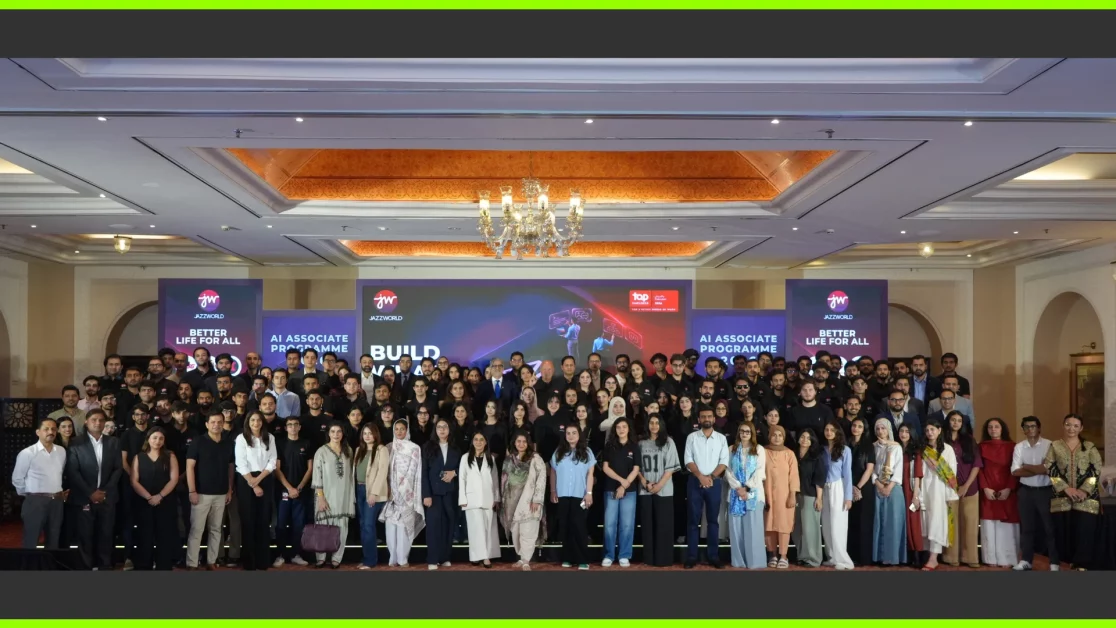
A hundred new recruits, zero relocation required
Somewhere in Pakistan right now, 100 people just got handed a front row seat to the most disruptive technology of our generation, and they didn’t have to move to San Francisco to get it. JazzWorld’s AI associates program quietly kicked off its first cohort, and if you’re the type who scrolls past “corporate training program” headlines, stick around anyway. This one’s less HR announcement, more early signal of where the job market is actually headed.
So what actually happened
JazzWorld, the parent company behind Jazz, just inducted the first batch of its year-long AI associates program. A hundred young professionals, picked through a nationwide search, are now being placed across fintech, cybersecurity, data science and analytics, software development, and digital platforms. Not in a classroom. Not in a lab somewhere doing case studies about hypothetical companies. Inside actual teams, working on actual business problems, right now.
The basic idea
Strip away the corporate branding and the program is simple: take young talent, give them a year of structured exposure to how AI actually gets used inside a real organization, and embed them with teams instead of parking them in a separate training silo. It’s less “AI bootcamp” and more “apprenticeship for the algorithm era.”

Skipping the sandbox
Most AI training programs teach you to prompt a chatbot or fine-tune a model in a sandbox that has nothing to do with your actual job. This one skips the sandbox. Associates are placed alongside existing teams and exposed to live customer and business challenges from day one. The theory, and it’s a reasonable one, is that you don’t learn how AI creates value by reading about it. You learn by watching a real workflow get redesigned around it, mistakes and all.
This isn’t just for the coders
Here’s the part people miss: this isn’t a program for future machine learning engineers. It’s built for finance people, marketers, cybersecurity analysts, and operations folks too. Because AI isn’t staying in its lane anymore. It’s becoming a baseline capability, like knowing Excel used to be, except with much higher stakes and a much steeper learning curve. The organizations that win won’t be the ones with the fanciest models. They’ll be the ones with people across every department who know how to actually use them.
What the world’s numbers say
This isn’t just Pakistan playing catch up for the sake of it. The World Economic Forum’s Future of Jobs Report 2025 projects 170 million jobs could be created globally by 2030 while 92 million could be displaced, netting out to a gain of 78 million jobs, with AI, big data and cybersecurity flagged among the fastest growing skill areas.
Meanwhile the International Labor Organization’s 2025 index found roughly one in four workers sit in occupations with some exposure to generative AI, though it leans toward transformation over wholesale replacement, since most jobs still need a human in the loop somewhere. Translation: the robots aren’t coming for everyone’s job, but they’re absolutely coming for how everyone does their job.

And closer to home
Pakistan’s own data tells a similar story on a smaller stage. The World Bank’s Digital Progress and Trends Report 2025 found that vacancies requiring AI skills in Pakistan doubled between 2021 and 2024, with more than 1,000 GenAI related job openings recorded in the country in 2024 alone. That’s not Silicon Valley numbers, but it’s not nothing either. It’s a market waking up.
The catch nobody advertises
Here’s where the op-ed part kicks in, because none of this happens automatically. A young, large population is a demographic advantage on paper. It only becomes an AI advantage if people actually get the skills, the computing access, and the organizational structures to use them. Otherwise you just have a lot of people who know what ChatGPT is, which frankly, at this point, is everyone.
From AI-enabled to AI-native
At the induction, JazzWorld CEO Aamir Ibrahim framed the shift in three stages: AI enabled, where companies bolt AI onto existing work; AI first, where products and processes get rebuilt around it; and AI native, where entire solutions exist that simply couldn’t have without AI. Most companies, in Pakistan and elsewhere, are still stuck at stage one. Programs like this are a bet on getting further, faster.

“AI-enabled, AI-first, AI-native.”; Aamir Ibrahim, CEO, JazzWorld
A people problem in a tech costume
Because AI readiness keeps getting talked about like it’s purely a technology problem, something you solve by buying better GPUs or licensing a better model. It isn’t. It’s a people problem wearing a tech costume. Certifications and courses build knowledge, but applied capability, the kind that actually moves a business forward, only shows up when someone uses that knowledge on a real problem with real stakes.
The real test comes later
A hundred people won’t single-handedly transform Pakistan’s economy, and nobody claiming otherwise deserves to be taken seriously. But the real test for programs like this was never the headcount. It’s whether these 100 people go on to become the ones who quietly change how their teams work, one workflow at a time. That’s a slower story than the launch headline, but it’s the one worth actually watching.