
Alibaba Expands AI Support for Pakistani SMEs
June 17, 2026
Pakistan’s ITANZ Lands $5M UAE Digital Transformation Deal
June 18, 2026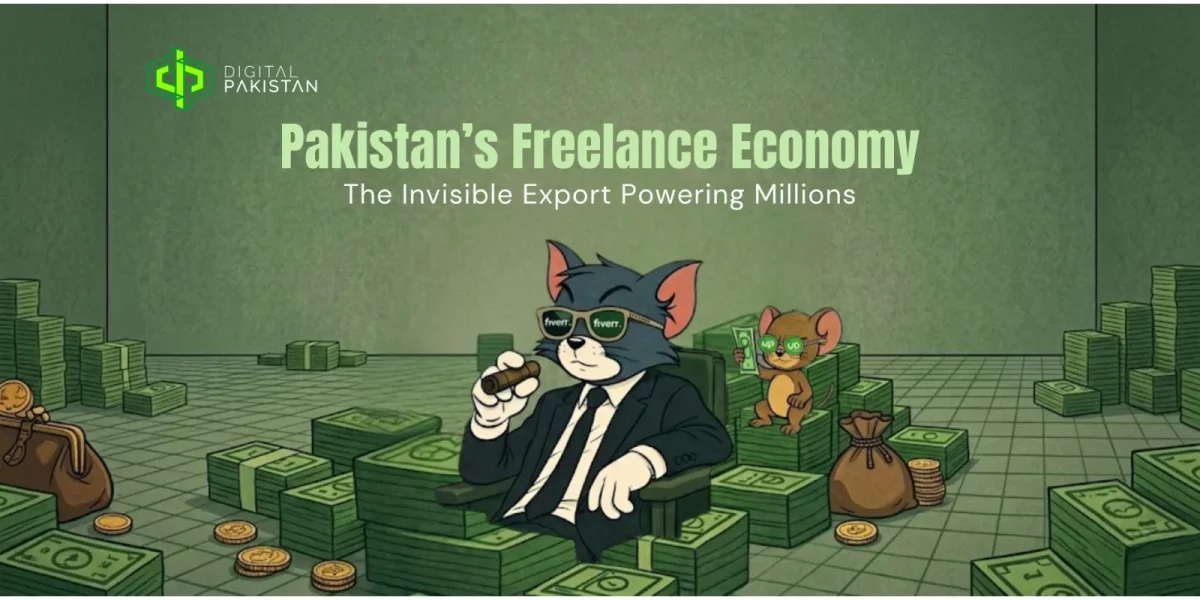
The Pakistan freelance economy has become one of the country’s most significant export stories, yet it remains largely invisible in public debate. Unlike traditional exports, there are no factories, shipping containers, or industrial zones attached to it. Instead, millions of dollars enter Pakistan through software developers in Lahore, designers in Karachi, marketers in Islamabad, and freelancers working from homes in cities that rarely appear in economic reports.
In the first nine months of FY2025-26 alone, Pakistani freelancers earned $856 million in computer and IT services exports according to State Bank of Pakistan data. With a full fiscal year still in play, the $1 billion milestone is no longer a target. It is an expectation, it represents a different model of economic participation, one built on digital skills rather than physical infrastructure.
This is not a fringe activity. It is one of the country’s most resilient and fastest-growing sources of foreign income, powered by a workforce of over 2.37 million registered freelancers according to an Asian Development Bank estimate. Yet for all its scale, Pakistan’s freelance economy remains poorly understood, inconsistently supported, and largely invisible to the financial and regulatory systems meant to absorb it.
This piece breaks down the numbers, the platforms, the people, the money trail, and the structural questions that will determine whether Pakistan turns a freelancing boom into a durable export industry.
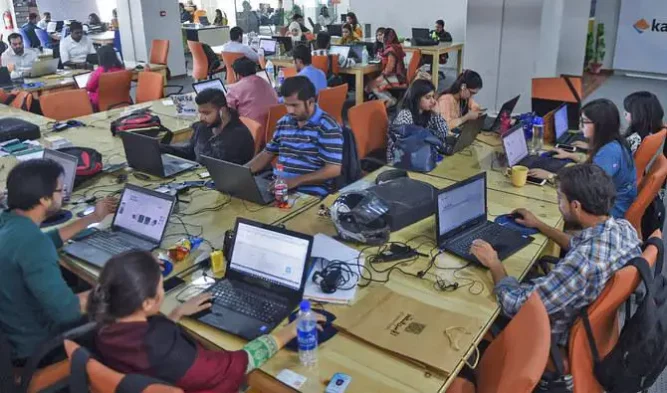
Image Source: Pakistan Today
How Large is Pakistan’s Freelance Sector, really?
The $1 Billion Milestone and What State Bank Data Shows
The headline figure from SBP data for July 2025 to March 2026 is $856 million in freelance earnings from computer and information services. That represents a 50 percent increase over the $567 million recorded in the same period of FY2024-25. In the first half of FY26 alone, July to December 2025, freelancers earned $557 million compared to $352 million a year earlier, a 58 percent year-on-year jump.
Pakistan’s total IT exports for the nine-month period reached $3.39 billion, up 20 percent year-on-year. Freelancers account for roughly one in every four dollars of that figure. IT Minister Shaza Fatima Khawaja confirmed these numbers to the National Assembly in April 2026, describing the freelance surge as a major milestone for the country’s digital economy.
The government had set a $5 billion IT export target for FY26. Analysts at Topline Securities now expect the sector to close the year at around $4.5 billion, up from $3.8 billion in FY25. Under the Uraan Pakistan economic plan, the government is projecting $10 billion in IT exports by FY2029. Freelance earnings are the most accessible and scalable component of that ambition.
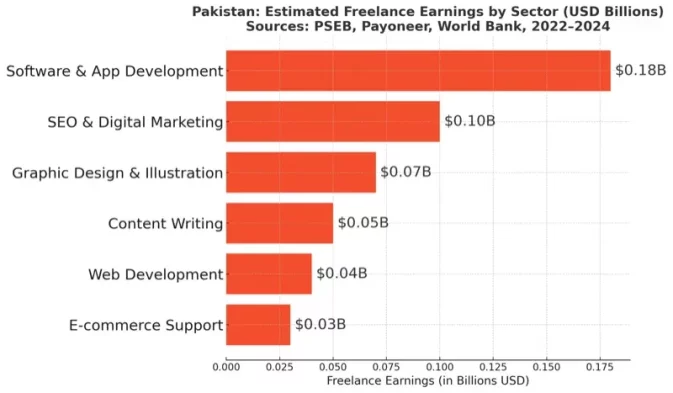
Image Source: World Population Review
Pakistan’s Global Freelancing Position and Why It Matters
Pakistan is consistently ranked among the top three or four countries on major global freelancing platforms. The Pakistan Economic Survey 2024-25 described the country as the second-largest provider of digital labour globally, with strengths spanning software development, creative services, and clerical support.
DigiSkills.pk, the government’s free online training platform run by Ignite National Technology Fund in partnership with the Virtual University of Pakistan, has delivered over 4 million training completions since its launch in 2018, including more than 800,000 to women. The programme expanded significantly in 2025 with a Rs 1.79 billion budget under DigiSkills 3.0, adding new courses in areas like AI using Python, full stack development, cloud computing, and UI/UX design, with a target of an additional 3 million trainings.
That pipeline of entry-level talent is one reason Pakistan punches above its weight in raw freelancer volume. The separate question is whether those numbers translate into high-value, well-paid, formally recognised work.
Platform by Platform: Upwork, Fiverr, and Where the Real Money Is
Upwork vs Fiverr: What Pakistani Freelancers Are Actually Choosing
Fiverr is the most popular platform among Pakistani freelancers by traffic and registration numbers, accounting for a significant share of the platform’s total global traffic. It is widely used for fixed-price services across graphic design, digital marketing, content writing, and video editing, with a low barrier to entry that makes it accessible for beginners.
Upwork commands higher average hourly rates and suits freelancers with more experience who can compete for project-based contracts. The platform requires a stronger profile, proposal writing, and client communication skills. Among Pakistani freelancers, Upwork is the preferred route for those targeting long-term contracts and higher per-project earnings.
The practical difference is this: Fiverr allows you to start with a phone and a well-written gig description. Upwork rewards a track record. Most Pakistani freelancers who reach consistent dollar-earning levels operate across both, using Fiverr for inbound volume and Upwork for relationship-based higher-value clients.
Toptal, LinkedIn, and the Direct Client Market
Beyond Upwork and Fiverr, Toptal operates as a highly selective network that accepts only a small percentage of applicants and commands premium rates. Pakistani developers and designers with Toptal status represent a small but growing tier of the market, typically earning significantly more per hour than platform averages.
LinkedIn has become increasingly important as a direct client acquisition tool, particularly for Pakistani professionals in fields like content strategy, software architecture, and financial analysis. Working off-platform eliminates commission structures and allows freelancers to build direct retainer relationships, though it requires a strong personal brand and professional network.
The direct client market, where a freelancer invoices a client without any platform intermediary, is difficult to measure precisely but appears in informal surveys as the highest-earning segment. It also creates the most complex payment routing challenges, discussed in the section on money flows below.
Which Platforms Pay the Most?
Platform earnings reflect skill category, experience level, and client geography more than platform choice alone. That said, Upwork and Toptal consistently generate the highest reported hourly rates among Pakistani freelancers due to their emphasis on verified skills and longer-term project contracts.
Fiverr’s commission structure takes a flat 20 percent of each order. Upwork previously used a sliding scale, but of May 2025 moved to a variable fee model ranging from 0 to 15 percent per contract, set at the time the proposal is sent. Both platforms also introduce currency conversion costs when earnings move to Pakistani bank accounts.
For a freelancer earning $1,000 per month, platform fees of 10 to 20 percent plus a three to five percent withdrawal fee through Payoneer can reduce effective take-home before Pakistani taxes. The gap matters at scale and is one reason experienced freelancers move toward direct client work.
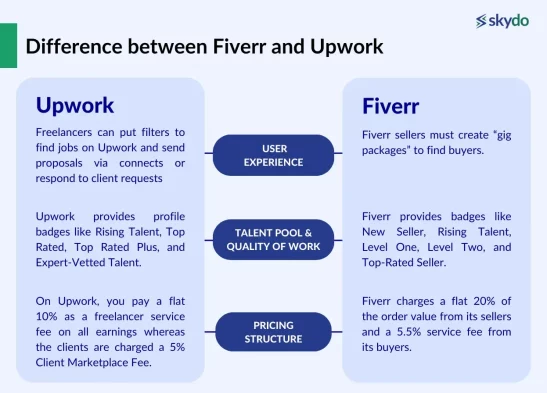
Image Source: Skydo
Who Are Pakistan’s Freelancers?
Demographics, Cities, and the Skills That Dominate
Roughly 60 percent of Pakistan’s freelancers are in their twenties and thirties. The workforce is young, largely self-taught or trained through government digital skills programmes, and concentrated in urban centres. Karachi, Lahore, Islamabad, and Faisalabad are dominant freelancing hubs, with the majority of activity concentrated in these four cities.
Top skill categories among Pakistani freelancers include software development and web programming, graphic design, digital marketing, content writing, video production, and virtual assistance. Software development produces the highest per-project earnings. Content writing and design are the entry points for most beginners and form the largest segment by headcount.
Beyond the four major cities, places like Multan, Sargodha, and Sialkot are developing visible freelancing communities, often anchored by a local mentor, a YouTube channel, or a community group like Digital Kasur, which was founded by freelancer Rizwan to mentor young people in his home district and now has over 32,000 members.
The Rise of Women Freelancers from Tier-2 Cities
One of the more significant and underreported dimensions of Pakistan’s freelance economy is the participation of women, particularly from tier-2 cities and smaller towns. DigiSkills has delivered more than 800,000 training completions to women since 2018. For many, freelancing offers a form of income generation that does not require leaving the home, navigating public transport, or negotiating with family over work commutes.
Women are active across graphic design, content writing, digital marketing, and data entry. Fiverr in particular, with its low entry barrier, has become a starting point for women building their first dollar-earning profile. Organisations like PAFLA have cited growing women’s participation as one of the defining structural shifts in the sector over the past two to three years.
The challenge is that women’s freelance income is even less likely to be formalised, taxed, or captured in official statistics than the overall sector, which means the actual contribution of women to Pakistan’s digital export economy is likely being undercounted.
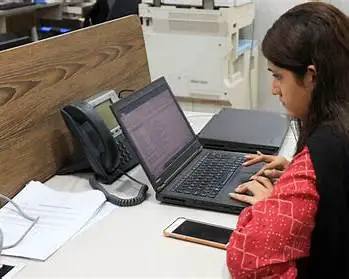
Image Source: Dawn News, Reuters
How the Money Flows and Where It Gets Stuck
From Payoneer to SadaPay: The Payment Pipeline
PayPal has never operated in Pakistan due to State Bank of Pakistan foreign exchange controls and anti-money laundering compliance requirements. It remains unavailable in 2026. The payment infrastructure Pakistani freelancers use instead has evolved considerably over the past few years, but it still involves friction that costs money at each step.
Payoneer is the dominant intermediary for marketplace-based freelancers. Upwork and Fiverr both pay directly to Payoneer accounts, which can then be transferred to Pakistani bank accounts or to newer fintech platforms like Sadapay and Nayapay. Wise is the preferred route for direct client payments, offering lower conversion costs than traditional SWIFT wires and better rates than Payoneer in most cases. Direct SWIFT transfers to Pakistani banks are the most expensive option due to correspondent banking fees and unfavourable conversion rates applied at source.
For most freelancers in 2026, the recommended stack is Payoneer for marketplace clients, Wise for direct client billing, and a local bank account registered under IT export codes to access tax benefits. The difference between the worst and best payment routing choice can represent three to five percent of each invoice, which at scale is substantial.
Foreign Exchange Rules and the Grey Zone
The SBP requires that at least 80 percent of foreign freelance earnings be repatriated through official banking channels within the fiscal year to qualify for IT export tax benefits. Income received through unofficial routes, peer-to-peer transfers, or held indefinitely in Payoneer without being remitted to a Pakistani account falls outside that framework.
The government has made some progress in simplifying this. Freelancers are now permitted to retain up to 50 percent of their foreign income in dollar-denominated accounts, which reduces pressure to convert at unfavourable interbank rates. PSEB-registered freelancers qualify for the 0.25 percent withholding tax rate on foreign remittances. The broader challenge is that a significant portion of the freelance workforce operates informally, collects payments through methods that bypass the official remittance system, and simply does not interface with FBR or SBP at all.
What Freelancers Actually Earn?
Take a freelancer earning $1,500 per month on Upwork. Upwork’s commission at that volume is approximately 10 to 15 percent. After fees, the gross remittance is around $1,275 to $1,350. Payoneer charges a flat 3 percent withdrawal fee when moving funds to a Pakistani bank account, following its May 2025 fee revision. The bank applies a conversion rate that may be 0.5 to one percent below the interbank rate. PSEB-registered freelancers then pay 0.25 percent in withholding tax on the remitted amount.
The result is a net take-home meaningfully below the gross billing figure. That is not extreme by international standards, but for freelancers operating at lower volumes, even a two or three percent saving on payment routing makes a meaningful difference to monthly income.
The Formalisation Problem
Why So Much Freelance Income Goes Undeclared
The majority of Pakistan’s freelance earnings are not formally declared to FBR. This is not primarily a deliberate act of tax evasion. It reflects a combination of factors: low awareness of tax obligations among young freelancers, a bureaucratic registration process that feels disproportionately complex for individuals earning modest amounts, a widespread assumption that foreign income is simply not taxable in Pakistan, and a lack of enforcement that has historically made non-filing low-risk.
Many freelancers also receive payments through Payoneer accounts that are never formally linked to a Pakistani bank, or through informal routing mechanisms entirely outside the banking system. That income does not appear in SBP data, does not generate a withholding tax event, and is not reported in any annual return. It is simply invisible.
The Role of PSEB and FBR
The Pakistan Software Export Board offers registered freelancers reduced withholding tax rates, access to training programmes, participation in international business development events, and eligibility for various government-backed financial facilities. Registration is free and straightforward for individuals with a CNIC. PSEB-registered freelancers pay 0.25 percent on foreign remittances compared to one percent for unregistered individuals.
FBR’s position is clearer in writing than in practice. Section 154A of the Income Tax Ordinance sets out withholding tax obligations. Section 65F provided a full exemption on IT export income until June 30, 2026, subject to conditions around remittance channel compliance. What FBR has not yet managed is effective outreach to the freelance community, simple self-assessment tooling designed for individual digital workers, or enforcement mechanisms that distinguish between non-filers through ignorance and deliberate avoidance.
The result is a sector where policy exists on paper but reaches only a fraction of those it is meant to govern.
What a Formalised Sector Could Look Like
Formalisation does not have to mean a heavier tax burden. Pakistan already offers one of the most freelancer-friendly tax structures in the region, with effective rates as low as 0.25 percent for PSEB-registered exporters. The untapped opportunity is to make that structure accessible and automatic rather than elective and obscure.
A formalised sector would mean more accurate data on actual earnings, greater bargaining power for Pakistan in international digital trade negotiations, a larger pool of documented income that freelancers can use to access credit, housing finance, and insurance, and a tax base that grows proportionally with sector growth. It would also allow PSEB and the Ministry of IT to make smarter investment decisions about where skills development is most needed.
The practical steps are straightforward in principle: integrate PSEB registration directly into platform onboarding for Pakistani accounts, create a simplified annual return for individuals earning under a threshold, and automate withholding tax through Payoneer and Wise at source rather than expecting freelancers to self-report. None of this requires new legislation. It requires coordination between institutions that have not yet worked together effectively.
|
Pakistan Freelance Economy at a Glance |
|
$959 million – Freelance export earnings in the first 10 months of FY2025-26 49% growth – Increase compared to the same period a year earlier 3 million freelancers – Estimated size of Pakistan’s freelance workforce Top platforms – Upwork, Fiverr, LinkedIn, Toptal, and direct client networks Major export categories – Software development, digital marketing, graphic design, content writing, and e-commerce services Key trend – Freelancing is becoming one of Pakistan’s fastest-growing sources of digital export revenue |
Conclusion
Pakistan’s freelance economy is real, large, and growing faster than almost any comparable export sector in the country. A 50 percent year-on-year earnings increase is not a statistical anomaly. It reflects a structural shift in how a generation of Pakistanis is building income, and how Pakistan earns foreign exchange.
What it is not yet is organised. The workforce is fragmented across platforms and cities. The payment infrastructure works but leaks value at every step. The regulatory framework exists but reaches only a minority of the people it is designed to help. And the data, impressive as it is, still undercounts what is actually happening.
The $1 billion annual milestone is effectively here. The question for policymakers, platform operators, and the freelancers themselves is what they build on top of it.
FAQs
How much do Pakistani freelancers earn?
Pakistani freelancers collectively earned $856 million in the first nine months of FY2025-26, according to State Bank of Pakistan data. Individual earnings vary widely by skill category and experience level, from a few hundred dollars per month for beginners to several thousand for experienced developers, designers, and consultants.
Is freelance income taxable in Pakistan?
Yes. Freelancers earning from foreign clients are subject to withholding tax under Section 154A of the Income Tax Ordinance. PSEB-registered freelancers pay 0.25 percent on foreign remittances received through approved banking channels. Non-registered freelancers pay one percent. A full exemption under Section 65F was available until June 30, 2026 for qualifying IT exporters. All freelancers earning above PKR 600,000 annually are required to file an income tax return through the FBR IRIS portal.
Which platform is best for Pakistani freelancers?
Fiverr is the most widely used platform by Pakistani freelancers due to its lower barrier to entry, while Upwork typically yields higher per-project rates for more experienced workers. Toptal caters to a small premium segment. For direct client billing, Wise and Payoneer are the most cost-effective payment channels available in Pakistan.
Does PayPal work in Pakistan?
No. PayPal is not available for Pakistani accounts in 2026 due to SBP foreign exchange regulations. Payoneer and Wise are the standard alternatives for receiving international freelance payments.
What is PSEB and why should freelancers register?
PSEB is the Pakistan Software Export Board, a government body that supports the IT and IT-enabled services sector. Freelancers registered with PSEB qualify for a reduced 0.25 percent withholding tax rate on foreign earnings, compared to the one percent rate for unregistered individuals. Registration is free and requires only a CNIC and basic business information.
Which cities in Pakistan have the most freelancers?
Karachi, Lahore, Islamabad, and Faisalabad are Pakistan’s dominant freelancing hubs. However, cities like Multan, Sargodha, Sialkot, and Peshawar are developing active freelancing communities, and the remote nature of the work means geographic barriers matter less than internet access and skills.