
PMO Task Force Reviews Telecom Power Tariffs
November 12, 2026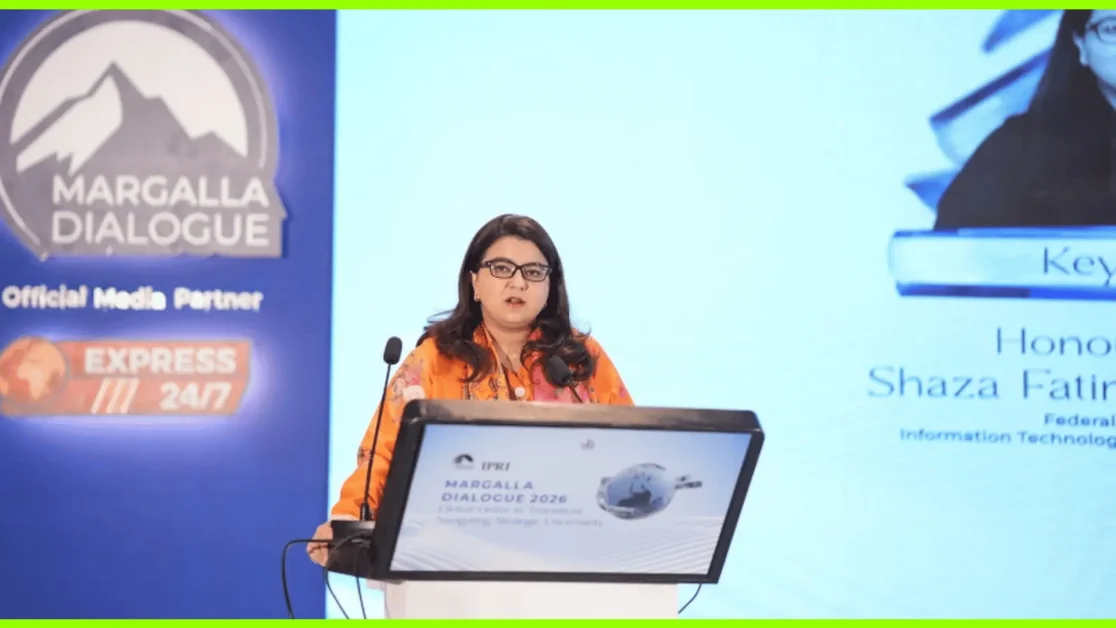
IT Minister Shaza Fatima Khawaja told Margalla Dialogue 2026 that AI could become a $4.8 trillion sector by 2033, touching 40% of global jobs, as Pakistan pushes for technological sovereignty.
Who will steer the AI revolution, and whose values will it carry? Pakistan’s IT minister put that question at the center of a high-profile policy debate in Islamabad.
Speaking on the second day of the Margalla Dialogue 2026 on Wednesday, November 11, IT Minister Shaza Fatima Khawaja said Pakistan is determined to turn global technological change, particularly rapid AI advancement, into national development, economic growth and technological sovereignty, Dawn reported. She was addressing a panel on technology and the transformation of state and society.
Khawaja said technology is reshaping every part of life, from education and healthcare to finance, social security and national security, and that AI is accelerating the shift. Her forecast is that AI will become a $4.8 trillion economic sector by 2033 and affect roughly 40 percent of the global employment landscape. The nature of work is changing, she said, which makes future skills and the ability to use AI effectively increasingly important.
The message fits a wider government push. Planning Minister Ahsan Iqbal recently said Pakistan aims to develop one million AI professionals by 2030, as Dawn reported.
The panel also looked at AI inside government. Pakistan Digital Authority Executive Director Dr Rehan Tahir said the authority’s key role is linking and coordinating the databases of federal and provincial governments. Service quality, he argued, can improve only when quality data is available.
International speakers added a note of caution. They said public trust in fully AI-based government services remains low, with failures seen in many countries. Akira Igata of the Economic Security Intelligence Lab at Tokyo University noted that criminals and lawbreakers are actively using advanced technologies and AI. He said Japan could learn from Pakistan’s experience in dealing with terrorists.
Retired Brig Dr Rashid Wali Janjua warned that new security threats would come from AI and the changing face of war, with warfare becoming more lethal, customised and precise, and much faster, with AI’s help.
What to watch: the minister’s framing treats AI as a question of sovereignty and skills, not only economics. Whether Pakistan can build the workforce, data quality and public trust the panel described will decide whether the opportunity becomes real. Dawn’s report did not mention any new policy announcements or funding figures from the session.