

Pakistan, Switzerland Explore Broader Economic Cooperation Opportunities
June 22, 2026
Oil Industry Warns of Rs105bn Losses
June 23, 2026
Pakistan’s digital economy did not get to $3 billion in exports by accident. It got there despite connectivity gaps, not because of them. The bill is an imperfect attempt to fix something that needs fixing. The answer is to fix the bill, not to kill the idea.
First, the feedback, because it is important
The Pakistan Telecommunication (Re-organisation) (Amendment) Bill 2026 contains specific clauses that require clearer drafting before moving forward.
First, the proposed 30-day timeline for Right of Way requests allows for implied consent if a housing society or cooperative does not respond. For private stakeholders, the concern that passive non-responsiveness could automatically grant property access makes narrower legal boundaries necessary.
Second, the maximum penalty of Rs. 50 million for infrastructure obstruction requires a precise statutory definition. While the IT ministry clarified that these fines target post-agreement disruptions rather than initial refusals, embedding this reassurance directly into the legal text will provide essential security.
Third, the current dispute resolution mechanism routes disagreements to a government-nominated officer instead of an independent tribunal. This arrangement introduces a structural consideration, as the same entity promoting network deployment also oversees dispute adjudication.
Ultimately, public review strengthens legislative design. The recent discourse has served a constructive purpose by highlighting exactly where the statutory language needs sharper definition.
What the bill actually says, versus what people think it says
Having acknowledged the flaws, it is also worth being accurate about what the bill does not do, because several things circulating on social media are simply not true.
The bill does not give telecom companies the right to install towers on private homes. Residential property cannot legally be used for commercial installations under existing Pakistani law, and the amendment does not change that. Fiberization and tower deployment are happening in different places: roads, rights of way, housing society common areas, government-owned land.
The fines are not a flat rate. The bill says “up to Rs. 50 million”, and any penalty has to be proportionate to the actual situation. Naveed Khalid Butt, Group Chief Regulatory Officer at PTCL and Ufone, explained this in a comment that received significant attention on LinkedIn: a private individual cannot be fined simply for refusing a request or negotiating terms. The fine only applies where a right of way has already been lawfully agreed, and someone subsequently obstructs it.
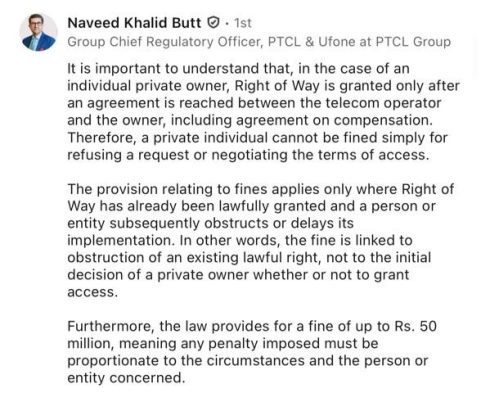
Naveed Khalid Butt, Group Chief Regulatory Officer at PTCL & Ufone, clarifying the fine structure on LinkedIn
The bill is also not law yet. It passed the National Assembly on June 11. It is currently before the Senate Standing Committee on IT and Telecommunication, where elected representatives are reviewing it. Any bill can be amended at this stage, and bills routinely are, that is precisely what the Senate committee process exists to do.
The infrastructure problem is real, and it has been real for years
Pakistan has a connectivity gap. Fiber penetration is low. Tower deployment is slow. Much of rural Pakistan remains underserved, and even urban areas see inconsistent broadband quality. This is not a new observation, it has been said by operators, regulators, and international bodies for years.
PTCL and Ufone CEO Hatem Bamatraf wrote about this directly on LinkedIn this week, calling attention to the gap between Pakistan and regional peers in fiber penetration and broadband infrastructure. His argument was that closing this gap is not just a telecom issue, it is an economic one.
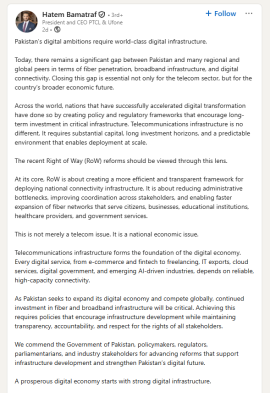
Hatem Bamatraf, President and CEO of PTCL & Ufone, on the national case for digital infrastructure investment
He is right about the economics. Telecom infrastructure, in every country that has prioritized it, functions as foundational economic infrastructure, similar to roads or electricity grids. Countries that have built out reliable high-speed networks tend to grow their service sectors faster, attract more foreign investment in technology, and create larger domestic digital economies.
In rural Pakistan, the practical challenge is compounding. Getting a landowner to agree to a tower or fiber cable crossing their land can take months, and agreed contracts are sometimes reneged on once the operator has made investment decisions. The Right of Way problem is not abstract. It is the specific reason a village 40 kilometers from a city can remain on 2G while the city has 4G.
The freelancers who built a billion-dollar export sector on connectivity
Here is a number that should contextualize this debate: in the first eleven months of fiscal year 2026, Pakistan’s freelancers earned $1.6 billion in verified export remittances — 80 percent growth, year on year.
IT exports overall are on track to cross $4.5 billion this fiscal year, up from $3.8 billion last year. Freelancer earnings alone, at $856 million through the first nine months, now account for roughly one in every four dollars of that total. The Finance Ministry expects the full-year freelance figure to cross $1 billion.
This money does not sit in a bank. It enters local households, is spent at local businesses, and strengthens the rupee by adding to foreign exchange reserves. The IT sector now accounts for over 10 percent of Pakistan’s total exports, for the first time ever. The 34,420 IT and IT-enabled services companies now registered with the SECP represent real jobs, real businesses, real tax contributions.
None of that is possible without connectivity. The freelancer in Multan needs upload speeds that let him deliver a video project. The developer in Faisalabad needs a stable connection to stay on a client call with someone in Toronto. Every rupee of that $1.6 billion traveled over telecom infrastructure, and the argument for better infrastructure is partly an argument for more of those rupees.
What every serious country understands about digital infrastructure
There is a dimension to this debate that has been largely absent from public discussion: telecommunications infrastructure is considered critical national infrastructure in every country that takes digital sovereignty seriously.
In the United States, telecom networks are classified under the Communications Sector as critical infrastructure, alongside energy and water. In the European Union, the European Electronic Communications Code gives member states authority to designate networks as critical and to override local objections in deployment. India’s Right of Way Rules from 2016 established exactly the kind of streamlined access framework that Pakistan is now trying to build. These are not authoritarian overreaches, they are the frameworks that made broadband rollout possible at scale.
Connectivity gaps are not just economic problems. A region that cannot be reliably connected is also harder to govern, harder to provide emergency services to, and harder to integrate into national digital systems. “Black sites” in connectivity terms — areas with no network coverage — create real vulnerabilities in any modern state’s digital architecture.
The direction is right; the language needs work
Aamir Ibrahim, a prominent telecom sector voice, put the case for the bill clearly on X (formerly Twitter), while acknowledging the legitimate concerns. His point was that the debate around the Telecom Amendment Bill had, in some ways, obscured the actual problem: fiber cannot be laid, towers cannot be deployed, and networks cannot expand without resolving Right of Way bottlenecks that have frustrated operators and slowed digital progress for years.
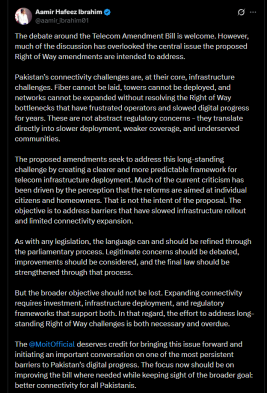
Aamir Hafeez Ibrahim on X, arguing that the Right of Way reform is necessary even if the bill’s language needs refinement
His other point is also worth keeping: as with any legislation, the language can and should be refined through the parliamentary process. That is the Senate committee’s job right now. Legitimate concerns should shape the final text.
IT Minister Shaza Fatima Khawaja tabling this bill was a step in the right direction. The problems Pakistan’s digital economy faces are not going to be solved by keeping the Right of Way framework broken. But a bill that creates genuine ambiguity about property rights, that relies on press releases rather than clear statutory language to reassure citizens, is not a finished product. It is a first draft.
The Senate should do its job: narrow the scope of automatic consent, define “obstruction” precisely, establish independent dispute resolution, and make the text match what the IT ministry has been promising in public statements. If those changes are made, Pakistan gets a framework it genuinely needs. If they are not, the criticism will be just as valid the second time around.