
AJK Partners Zindigi to Digitize Water Billing
March 3, 2026
NBP, Arcana Info Launch Enterprise Service Bus Platform
March 3, 2026JazzWorld CEO Aamir Ibrahim Puts Pakistan’s Digital Finance Scale on the Global Stage at GSMA Mobile World Congress 2026
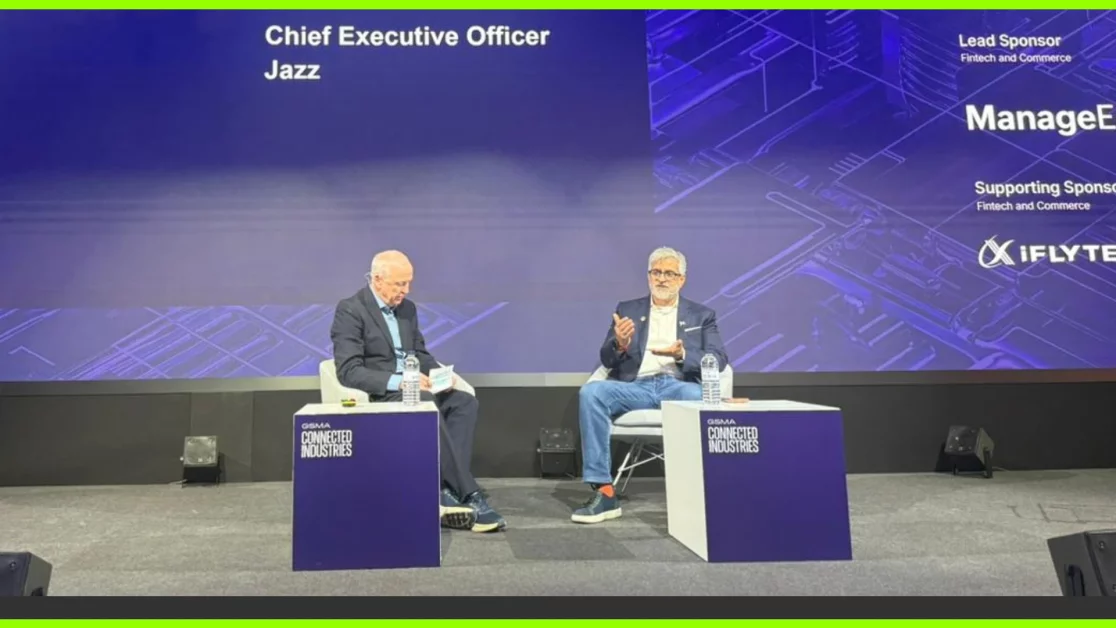
At the GSMA Mobile World Congress 2026 Fintech and Commerce Summit, Aamir Ibrahim, CEO JazzWorld and Chairman JazzCash and Mobilink Bank, described the current state of JazzCash not as a growth story but as a structural reality that Pakistan’s economy now depends on.
The Scale of the Platform
JazzCash serves close to 58 million customers, placing nearly one in three adults in Pakistan within its ecosystem. On the merchant side, over one million Raast QR-enabled businesses accept payments through the platform daily. In 2025, JazzCash processed PKR 15 trillion in gross transaction value, equivalent to approximately 13 percent of Pakistan’s national GDP.
“JazzCash is a full digital financial ecosystem. That is precisely why we were able to process PKR 15 trillion in gross transaction value in 2025, equivalent to roughly 13% of national GDP.” — Aamir Ibrahim, CEO, JazzWorld, Chairman JazzCash and Mobilink Bank
The people using JazzCash are not a homogeneous demographic. They are shopkeepers in small towns accepting QR payments in place of cash, salaried workers managing bills digitally, freelancers receiving income from abroad, families receiving welfare disbursements directly into wallets, and micro-entrepreneurs accessing credit for the first time because their transaction history has given them a financial identity. Pakistan’s mobile penetration has historically outpaced banking access by a significant margin, and that structural gap is what created the conditions for a platform to reach this scale. According to State Bank of Pakistan data, the country has made measurable progress on digital payment volumes over the last several years, and JazzCash’s transaction volumes represent a substantial portion of that national movement.
The Policy Architecture Behind the Numbers
The scale Ibrahim described at MWC does not exist in isolation from government policy. Pakistan’s Prime Minister’s Cashless Economy Initiative 2025 created a formal framework for the transition away from cash dependency, built on expanding digital payment adoption, strengthening interoperable digital infrastructure, and digitizing government-to-person and person-to-government payments. JazzCash is the most significant private-sector vehicle through which that policy is being executed in practice.
“Raast QR integration enables instant, interoperable payments at national scale. This gives merchants real-time settlement and documented transaction histories which are essential for unlocking formal credit and working capital.” — Aamir Ibrahim, CEO, JazzWorld, Chairman JazzCash and Mobilink Bank
The execution is measurable. In 2025, JazzCash disbursed over PKR 100 billion in welfare payments, removing intermediaries from the transfer of social funds to individuals, extended more than 200,000 digital loans daily, and issued over 750,000 insurance policies each day. Through JazzCash Tap, over one million merchants can now accept contactless payments without traditional POS hardware. JazzCash Bazar, built on mini-app technology with Huawei, extends the platform further into commerce enablement, allowing micro-entrepreneurs to create digital storefronts, integrate payments, and access lending within a single ecosystem.
Who Gets Counted, and Who Does Not
Ibrahim was clear at the summit that the platform’s scale only holds meaning if it is reaching the populations that formal finance has historically excluded. Women represent 34 percent of JazzCash’s current customer base, up from 30 percent the prior year, with a target of reaching 50 percent. The State Bank of Pakistan has set national financial inclusion targets of 75 percent and a gender gap reduction to 25 percent by 2028.
The mechanism is product design rather than outreach alone. Onboarding has been made fully digital with minimal documentation. Credit models use alternative data to serve women with informal or irregular income, and the JazzCash Women Account packages budgeting tools, savings benefits, built-in insurance, and a dedicated debit card as an integrated product.
“We intentionally over-index on inclusion, particularly for women, ensuring access to accounts, commerce, and financial tools that were previously out of reach.” — Aamir Ibrahim, CEO, JazzWorld, Chairman JazzCash and Mobilink Bank