
Pakistan, China Deepen Investment Coordination Efforts
December 25, 2025
Spotify Chaos: Catalogue Leak Sparks Global Artist Panic
December 25, 2025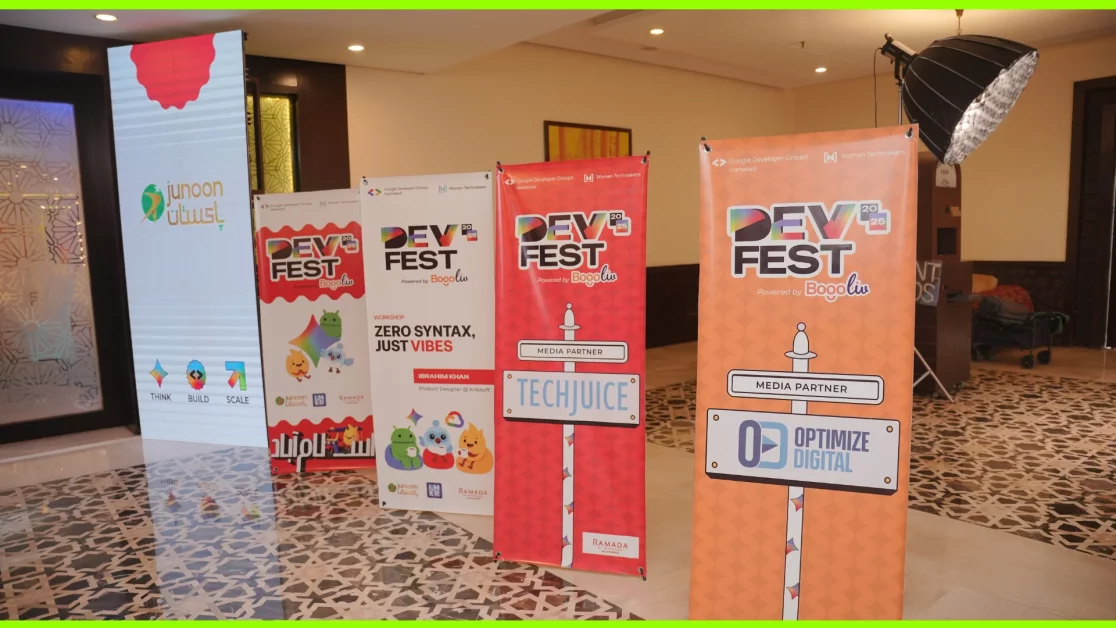
I have always been a tech nerd. If playing mobile games on laptops via emulators classifies you as one. But the tech world really fascinated me. But ever since university began, the closest I got to exploring the world of tech was using ChatGPT to make my assignments. So, when I got the opportunity to attend Google Dev Fest, I knew no answer except “absolutely yes”.
My scintillating Sunday began at 8 AM. After getting ready and having a brisk breakfast, I set off for Ramada, where the event was being held. After a 30-minute ride- shoutout to InDrive- I arrived in Ramada. As someone who was going there for the first time-and probably the last- I fell in love with the setting. But, since I had an event to cover for Digital Pakistan, I moved to the basement, where the event was being held. 9:30 – 10:30 was the time for registrations, so I got registered. Partners and participants were given a diary and pen, a wonderful gesture that facilitated note-taking. I then entered the hall where the event was taking place. Our beautiful standee of Digital Pakistan adorned the route leading to the event.
After recording the entrance shoot, I proceeded inside, just in time for the Welcome note by the Google Developer Groups, the hosts of the event. I got to see the community managers; Umar, Ali and Sarwat. Umar, in particular, carried a great sense of humor and had the cloud cheering and clapping for him. The community managers informed the audience of the history of GDG Islamabad and their journey with it. What really impressed me was the drive for inclusivity. A sign language interpreter was present, who signed the entire event for the differently abled. A mention of the sponsors and partners for the event was made, leading to a round of applause. Umar led a vibe check based on claps, something that made the event more interesting. A funny segment occurred when the screen displayed 4 different emojis, asking the crowd who they resonated with the most. There was the sad red, the decent yellow, the content green and the happy blue. The majority resonated with yellow and red, which was understandable.
After a small giveaway, the stage was set for the arrival of the chief guest; Secretary MOITT, Mr. Zarrar Hasham Khan! Mr. Zarrar had an open-heart conversation with the audience that wasn’t very government-centric but rather a testament of the truth. He engaged the audience, asked questions and talked about problems that faced the Pakistani ecosystem. He highlighted the government’s efforts and future plans to ensure that the people didn’t get left behind in this age of tech. A key figure that caught my attention was the fact that 6.7 lakh people in Pakistan are affiliated with tech.
After Mr. Zarrar, Aziz Kassamali, founder of BogoLiv, took the stage. He discussed his own journey and shared valuable insights with the audience. He stated the price of 1 MW of electricity for AI cost $10 million, a figure that I don’t think I will ever achieve. He further informed the audience that $120 billion was invested in AI globally. Towards the end, Aziz motivated the crowd, saying that we had to help ourselves to become a superpower.
A group photo then took place, featuring all the guests and participants. Being the photophobic person that I am, I found it better to stay in my cozy seat.
The next segment was “What’s new at Google”. Ali Naqi Rizvi, co-manager at GDG, addressed the audience. He talked about the evolution of AI from predictive to generative and, eventually, agentic. He discussed vibe coding, multimodality and the future of work. As someone who doesn’t utilize AI that very often, the updates on Gemini really caught my attention.
Anti-gravity is something that I thought was the opposite of gravity. I learnt that it is Google’s AI-powered development platform. This information was conveyed by none other than Danyal Khalid, a graduate in software engineering from NUST and a software engineer at Google in Munich, Germany. Danyal discussed the bottlenecks with respect to coding as syntax issues would arise previously. But now, with cognitive level understanding, this wouldn’t be an issue. He also informed the audience how the AI operated on the basis of Plan, Act, Verify. Upon hearing that the individual plan was free, I must say I became tempted to try it.
Up next was the introduction to NotebookLM, presented by Mahnoor Salman, co-founder of atomcamp. She enlightened the audience of the research aspect of AI. She said that gone were the days when people had to read through lengthy papers during their research journey. With NotebookLM, deep research could be done without going in-depth. Equipped with different formats, NotebookLM was making research easier and more convenient. She further stated the benefits of NotebookLM, limitations and best practices to extract the most efficient output.
Mahnoor was succeeded by Sharjeel Afzal, founder of UpAlerts, who presented “Prompt to Production”. He discussed how AI could not only be utilized for research and assignments but also to build applications that could create streams of revenue. My bad luck was that while he delivered this lecture, I had gone outside.
Next segment focused on Retrieval-Augmented Generation (RAG), another new term for me. Mughees Awan, a graduate of FAST and data scientist at Teradata, discussed RAG and its internal uses for companies.
Marium Aslam took the stage to talk about securing Large Language Models (LLMs). She discussed the dark side of LLM’s and how they could be jailbroken via certain prompts, resulting in piracy and other illegal actions. She talked about LLM testing, accuracy and how responsible AI worked. With the updates that she mentioned, it seemed like AI was heading to safer waters, with no-one able to cause harm via jailbreaking prompts.
A fun segment break came our ways in the form of a mini-giveaway. Although I didn’t win anything-not the first time- I did learn that GDG has been in existence since 2010 and that Google’s latest update was the Nanobanana. Nanobanana is an image generation tool, as I learnt that day. As the segment progressed, more knowledge came my way. Veo-video generation-, cloudrun and what not.
At this point, the clock read 1:30 PM and my stomach identified as hungry. Thankfully, the hosts came well prepared. And soon, the lunch began. Plentiful good food was present, alongside a sweet treat. As a hostelite, I must say that I didn’t mind coming to Ramada on a Sunday.
By the time the lunch was over, it was almost time to head back home. I recorded a couple of testimonials for Digital Pakistan. Hosts, guests and participants, all gave their views and each person carried excitement and energy. Umar was pleased with the success of the event and discussed his journey with GDG, giving advice for future. Participants were happy with the proceedings as well. Some took home beautiful souvenirs as well.
Post-lunch, a talk and a workshop took Centre stage before networking, pictures and giveaways closed out a wonderful Sunday.
As someone who had never ventured near the world of tech, this GDG was an interesting occurrence. I got to see a community that I thought only existed in other countries. I saw the value the country held for tech and vice versa. The energy amongst participants and hosts alike made me feel like I had been missing out on something all this while. But, as the saying goes, “The best time to plant a tree was 20 years ago. The second-best time is now.” Thank you to Digital Pakistan for granting me the opportunity to cover this event. I took something home that was far more valuable than souvenirs and food. It was an experience. Till next time, take care, stay safe and goodbye!
Yours Truly,
Muhammad Abdul Wasay