
Pakistan Launches PM Cloud Program
December 24, 2025
IFC, Standard Chartered Support Agri Financing Shift
December 25, 2025
Introduction: The Fall of The House of Cinema
Maybe it is the way that we dim-wittingly stare at multiple screens simultaneously, or perhaps it is a general digital overstimulation fatigue, but cinema just doesn’t feel like what it used to be. In the glory days of film making, the cast and crew had their skin in the game not just for money, but because they truly cared about the art and the audiences.
The writers delivered stories that rose to the occasion at every turn of the era; the directors used the camera as a conduit to access complex dimensions and redefine the limits of what can be achieved through a lens. The actors seamlessly blended with the bodies of their characters – with such superhuman versatility – in methods that felt raw, instinctual, haunting and whole.
Going to the cinema had felt like entering a cathedral: a hallowed space in which imagination was allowed to roam free, and audiences were treated as thinking beings rather than consumer clusters. Films were allowed to breathe, ache, stumble, and triumph. The artistry wasn’t perfect, but it was unapologetically alive.
Lately, lazy writing in streaming shows feels like the machine kept running, but the heartbeat is missing. The stories aren’t profound, nor fresh and soulful; directors and producers seem to only be interested in the next mega cash grab. Actors can’t embody a sincere expression ever since their facial muscles died from having undergone too many procedures. Has the cinematic empire met its waterloo?
Cinema isn’t collapsing overnight; it is slowly burning down to ash and debris. A disappearing phantom, faintly clinging to the spectacle of its golden age. A long, simmering erosion masked by glitter, box office jargon, and inflated red-carpet delusions. An industry so drunk on its own mythology that it didn’t notice the ground dissolving beneath it.
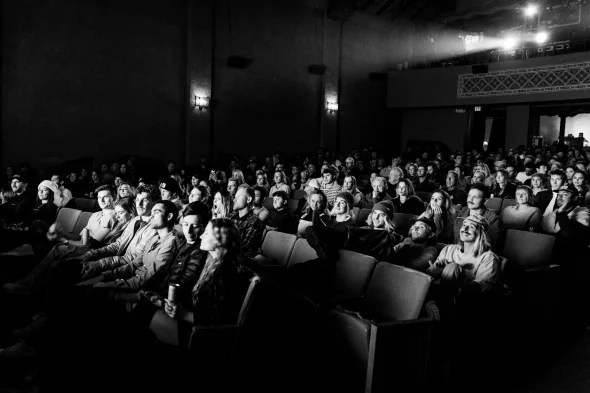
Image source: Unsplash
Not to mention the infiltration of actors engineered through artificial intelligence. What was once cinema became content. What was once risk became risk management. And what was once storytelling became an overcooked formula reheated until even the oven gave up. This is a tragedy of our own doing. A slow suicidal obliteration.
Netflix’s Conveyer Belt Cinema Problem
Netflix doesn’t make films. It manufactures content units. The production model is industrial, not artistic; It’s an assembly line efficiency applied to storytelling. Films are greenlit not because they’re urgent or necessary, but because they fill demographic gaps in the catalogue. The algorithm identifies what’s missing and directors become hired hands executing predetermined formulas.
The question isn’t “does this need to be told?” but “will this keep subscribers from canceling?” Cinema becomes a business strategy masquerading as art. The repetition is suffocating. How many times will we resurrect the likes of Marilyn Monroe and Elvis Presley from the dead, rehashing stories that are already burned into our memories. Let them rest in peace!
Some might argue that by telling these stories we’re keeping legends alive but the movies made in their honor are not even that high class. If anything, they’re corrupting and fabricating history more than it already is. Netflix’s library is a hall of mirrors reflecting the same tired narratives back at us infinitely. Biopics especially, endless biopics.
While we’re on the subject of mishandled representations of historical events, will Ryan Murphy please come to the front. Can we please get an insight into his mind and see what goes on there as he’s depicting real life serial killers in the most glamorized, romanticized and inaccurate light known to humankind.
This isn’t creative bankruptcy by accident. It’s strategy. Netflix discovered that familiarity breeds completion. Viewers finish what feels recognizable, what doesn’t demand too much cognitive effort, what can be half-watched while scrolling Instagram. So, they optimize for predictability. Every film must hit the same beats, trigger the same responses, deliver the same comfortable catharsis.
Image source: Unsplash
The reason why Netflix shows have bad writing is because risk is a liability. Originality is expensive. Netflix writing problems are contingent on the perpetual motion of the conveyor belt. The content keeps dropping, and real cinema that dares, stumbles, haunts, gets buried under an avalanche of algorithmically perfected mediocrity.
The Murder of The Theatrical Experience
Cinema was never just about the film, it was about the journey to witness it. The deliberate act of leaving your home, standing in line, surrendering your phone, sitting in darkness with strangers. That communal vulnerability is now extinct. Netflix turned the cathedral into a living room. The sacred became casual. The event became background noise.
We don’t have opening weekends anymore. We have drop dates that come and go like whispers. Films premiere on a Tuesday at 3am and vanish into the content graveyard by Friday afternoon. No lines around the block. No sold-out shows. No collective gasp when the plot twists.
No shared silence during the credits while everyone processes what they’ve witnessed. Netflix killed the ritual. Films now compete with laundry, dinner prep, and scrolling Twitter. The biggest cinematic releases of the year debut between true crime documentaries and baking competitions. Everything flattened into the same infinite scroll of disposable entertainment.
The theatrical experience demanded your attention. The ticket price, the journey, the physical commitment, it all conspired to make you present. Netflix offers the opposite: infinite choice with zero commitment. You can stop, start, switch, scroll. Cinema becomes ambient content for multitasking.
When Hollywood Royalty Becomes Contract Laborers.
The actors who once commanded theaters, who drew crowds by name alone, now churn out three, four, five films a year for the platform. The prestige evaporated the moment their work premiered between reality dating shows and true crime documentaries. There’s no hierarchy anymore. Except maybe in checklist diversity casting.
Image source: Unsplash
Everything exists in the same flat, infinite scroll, equally accessible, equally forgettable, equally worthless. Watch any A-lister’s Netflix filmography. It’s a blur of indistinguishable performances shot back-to-back in Eastern European studios with interchangeable casts and crews. They’re not building careers; they’re fulfilling content quotas. The mystique is gone.
Actors can’t even move their faces anymore to elicit a complete emotion. Emotion, the vital pulse and core essence of cinematic storytelling. But ofcourse, this is not Netflix’s problem as much as it is the entire industry’s. However, the platform neutered star power by making stars abundant. Scarcity created value. Netflix created surplus.
The platform points to their roster of the same exact popular, Instagram ready, faces and says, “Look, we’re serious about film.” But hiring prestigious actors to star in forgettable drivel is branding, not filmmaking. They’re not movie stars anymore. They’re content creators. And content, by its very nature, is disposable.
Films With Less Shelf Life Than Milk
Films trend for 72 hours, if they’re lucky, before their algorithmic burial. The platform’s own interface conspires against longevity. New releases push old releases into oblivion. Last month’s buzzed-about drama is already on page seven, buried under this week’s offerings. There’s no second life. No cult classic potential. No rediscovery twenty years later by a new generation.
Real cinema used to age like fine wine. The theatrical model gave films time to breathe, to find their audience, to build word-of-mouth. A slow-burn masterpiece could play for months, gathering momentum through reputation. Netflix operates on week-one metrics. If a film doesn’t immediately capture attention, it’s sentenced to the content graveyard.
In the Broadway musical, Hamilton, George Washinton sings about how we have no control who lives, who dies and who tells our story. To which Netflix says “hold my glass while I decide what lives and dies based on opening weekend numbers”. Why make something with lasting value when the platform’s architecture ensures obsolescence? This surface level storytelling is not art; this is not cinematic legacy.
Image source: Unsplash
Why craft a film that rewards repeat viewing when 90% of subscribers will watch it once, maybe, while folding laundry? Directors know their work has a 72-hour window before it vanishes. They optimize for immediate impact, big hooks, loud moments, anything to grab attention in the scroll.
Conclusion: Calling Time of Death on Cinema
The lack of subtlety in streaming content proves that cinema that requires patience or contemplation is incompatible with Netflix’s consumption model. The tragedy isn’t that Netflix exists. The tragedy is that we surrendered without a fight. We traded mystery for convenience, anticipation for immediacy, the communal for the isolated.
We chose comfort and called it progress. Now we sit in our living rooms, scrolling through thousands of options, watching nothing, feeling nothing, wondering why cinema doesn’t move us anymore. The answer is obvious: we stopped moving for it. Cinema’s tombstone will read “Murdered by convenience, owing to the apathy of the makers and audiences of stories.”
We can point fingers at Netflix, at algorithms, at corporate greed. But reality if often stranger and uglier than fiction. We chose this. Every time we stayed home instead of going to the theater. Every time we let a film play in the background while we checked our phones. We killed the thing we claimed to love because it demanded too much from us, our time, our attention, our presence.
And convenience, that sweet poison, promised we could have cinema without the cost. We believed it. Now we’re living in the aftermath, surrounded by content, starved for art, wondering what we lost and how to get it back. The couch became a coffin. We just didn’t notice until we were already lying in it.