
Pakistan, Canada Agree to Expand Trade and Investment
July 21, 2026
JS Bank Earns Three Asian Banking Finance Awards
July 22, 2026
Two major battery investments. National headlines. But are we building industrial capacity or just bolting together imported cells and calling it manufacturing?
What Actually Happened: The Dongjin and Karachi Investments
Separating Announcement From Substance
In May 2026, two stories ran side by side in Pakistan’s business press, and both used the word “manufacturing.” Whether that word is doing honest work is the question this piece tries to answer.
The first: China’s Dongjin Group signed a $15 million agreement with the Punjab Board of Investment and Trade to build a dry battery facility in Allama Iqbal Industrial City, near Faisalabad. Dongjin is a real, established manufacturer, headquartered in Shenzhen with lithium battery and lead-acid factories in Guangdong and Jiangxi provinces, more than 4,000 employees, and an R&D team exceeding 325 people. The company has had a presence in Pakistan since 2019 and began local operations in 2021, so this is an expansion rather than a first entry. The plant will sit inside a Special Economic Zone under the China-Pakistan Economic Corridor framework, carrying a 10-year income tax holiday and a one-time customs exemption on imported machinery.
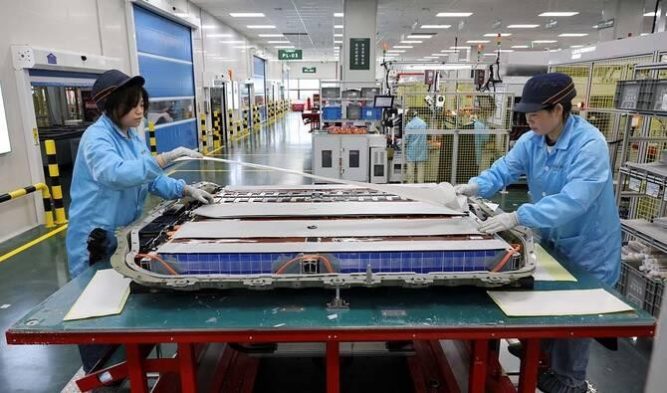
Battery assembly line workers at a Leapenergy factory in Huzhou, China, during a media tour – Photo by Reuters] Image Source: Arab News
The second: EV Technologies, a Karachi-based engineering firm, is preparing what is being described as Pakistan’s first lithium-ion battery production plant, in the Korangi Industrial Area. The initial capacity is modest by global standards, 4 megawatts, enough to supply roughly 2,000 e-bikes and e-scooters a month. Two other Karachi projects are moving in parallel: Wave Tech has announced a $200 million lithium battery plant at Malir Industrial Park, with construction slated to begin and production targeted for mid-2026, and Crown Group is finishing a lithium iron phosphate battery plant at Port Qasim, projected to produce 5,000 to 8,000 batteries per month at launch.
Read individually, these sound like the start of an industry. Read carefully, each announcement describes something narrower: assembling battery packs, combining cells, a battery management system, casing, and connectors,rather than producing the lithium-ion cell itself. The cell, where the actual electrochemistry happens, is the part of the supply chain none of these announcements claim to make.
This distinction is not pedantic. It is the entire question this article exists to ask.
Downstream Assembly vs. Genuine Manufacturing: Why the Distinction Matters
Value Capture, Employment Quality, and Technology Transfer
A lithium-ion battery has roughly four layers of production. At the bottom sit raw and processed minerals like lithium, graphite, cobalt, nickel, manganese. Above that are battery materials like cathode active material, anode active material, electrolytes, separators, foils. Above that is cell manufacturing, the actual electrochemical unit, built in a controlled, capital-intensive process. At the top is pack assembly, taking finished cells and wiring them into a battery management system, housing, and thermal controls for a specific end use, whether that’s an e-bike, a UPS, or an EV.
Pakistan’s current and announced projects sit almost entirely at the top layer. Dr Ghulam Ali, head of research at NUST’s U.S.-Pakistan Center for Advanced Studies in Energy, has flagged exactly this gap, naming battery-grade graphite, LFP or NCM cathode materials, aluminium and copper foils, separators, and electrolytes as the components Pakistan does not yet produce and would eventually need to. “A disruption in the supply of even one of these components could halt battery production entirely,” he noted. This is where the economics diverge sharply. Pack assembly is real, useful, and creates jobs, but the jobs are lower-skilled, the margins are thinner, and the value captured locally is a small fraction of the finished product’s price, because the most expensive and technically sophisticated component (the cell) is still imported. As Dr Ali put it, the long-term benefit lies “not only in battery production itself but in the supply chain and technical knowledge that develops around it” precisely the part Pakistan has not yet built.
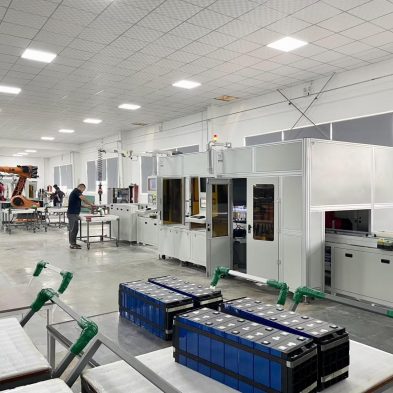
Automated lithium-ion battery pack assembly line for electric vehicle and energy storage applications – Photo by MadeinChina.com]]
Image Source: Made-in-China.com
Cell manufacturing is different in kind, not just degree. It requires cleanroom-grade environments, precision chemical processing, and specialised engineering talent. It is where genuine technology transfer would happen where Pakistani engineers would learn to formulate electrolytes, manage cell chemistry, and run quality control on something more demanding than a wiring harness. None of the current investments commit to this layer. The Dongjin plant is explicitly a “dry battery” facility assembly and finishing, not cell fabrication. The Karachi projects assemble lithium-ion battery packs from imported cells.
None of this means the investments are worthless. Assembly is a legitimate first rung it builds factories, trains a workforce in handling battery materials safely, and starts to displace some import volume. The risk is in the language. Calling pack assembly “manufacturing” without qualification invites a policy and public conversation that believes Pakistan is closer to supply chain independence than it actually is.
The Cell Import Dependency Problem
Where the Lithium-Ion Supply Chain Actually Lives and Who Controls It
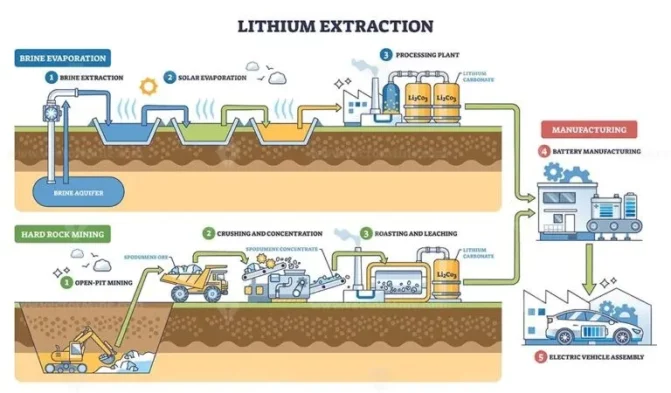
Lithium extraction from brine ponds, the raw material stage of the battery supply chain – Photo by Vectormine
The scale of global concentration in cell manufacturing is difficult to overstate. According to the International Energy Agency, China manufactured well over 80 percent of all lithium-ion batteries produced globally in 2025, with the European Union and the United States splitting most of the small remainder. Chinese, Korean, and Japanese firms together account for nearly all global cell output.
The dependency runs deeper than finished cells. China produced 79 percent of the world’s natural graphite in 2024 and exported 58 percent of the world’s processed battery minerals, while Chinese companies control roughly a quarter of global lithium mining capacity and 80 percent of cobalt production out of the Democratic Republic of Congo. China also accounted for 53 percent of the world’s battery material export trade in 2023. In short: even a country that builds its own cell factories tomorrow would still be importing the inputs that go into those cells from a market China dominates at almost every stage.
For Pakistan, this means the current battery import bill is not a temporary problem that a few assembly plants will solve. According to Pakistan Bureau of Statistics and State Bank of Pakistan data, battery imports surged to $101.8 million in the first five months of FY2025-26, compared to $56.6 million in the same period the year before — nearly doubling in a single year. Assembly plants that source finished or near-finished cells from China do not reduce this exposure; they simply relocate the final 10–15 percent of value-add to Pakistani soil while leaving the import bill for cells largely intact.
There is a partial domestic counterweight worth noting. Pakistani officials have pointed to the country’s reserves of phosphate, iron, and manganese inputs relevant to lithium iron phosphate (LFP) battery chemistry as a potential domestic materials base. This is a real opportunity, but reserves in the ground are not the same as a processing and refining industry, which Pakistan does not currently have at any meaningful scale. Translating mineral endowment into usable battery-grade material typically takes years and significant capital, even before a single cell is made.
Three Scenarios for Pakistan’s Battery Sector (2025–2030)
Scenario One: The Assembly Trap
Pakistan continues attracting pack-assembly investment more SEZ-incentivised plants doing final assembly on imported cells without ever building cell manufacturing or upstream materials capacity. Battery imports keep rising in dollar terms even as “battery manufacturing” headlines multiply, because the line item that moves is cells and components, not finished packs. Tariff relief on imported parts, while helpful for assemblers’ margins, removes one of the few incentives a domestic cell industry would need to compete. Pakistan ends the decade with more battery-branded factories and a similar or worse trade exposure than it started with
Scenario Two: Partial Integration
The National Lithium-Ion Battery Manufacturing Policy 2026–31 succeeds in its stated phased approach, localisation targets, tariff reforms, and performance-based incentives move in stages rather than all at once, and a handful of firms, likely joint ventures with Chinese or Korean partners, begin assembling cells locally from imported materials (cathode powder, separators, electrolyte) rather than just assembling finished packs from imported cells. This is a meaningful step up the value chain, though it still leaves Pakistan dependent on imported battery-grade materials. Local content requirements gradually increase, and a thin layer of Pakistani technical expertise in cell-level work begins to form. This scenario plausibly improves trade balance modestly and builds real industrial capability, without making Pakistan self-sufficient in any layer of the chain.
Scenario Three: Supply Chain Anchor
Pakistan successfully links its mineral reserves (phosphate, iron, manganese for LFP chemistry) to a domestic materials processing industry, attracts cell manufacturing investment specifically tied to that materials base, and uses EV and solar storage demand growth as a captive market to de-risk early local cell production. This is the scenario officials gesture toward when they talk about Pakistan becoming “a regional hub for battery manufacturing.” It is achievable in principle countries with far less mineral endowment have built cell industries but it requires sustained capital, multi-year policy consistency across different governments, and a level of foreign technology transfer that current agreements do not yet commit to. This is the highest-reward, highest-difficulty path, and the one for which the least concrete evidence currently exists.
Of the three, Pakistan’s current trajectory most closely resembles Scenario One, with the stated ambitions of the 2026–31 policy aimed at Scenario Two. Scenario Three remains aspirational rhetoric rather than committed investment as of mid-2026.
What Industrial Policy Would Need to Change
Local Content Rules, R&D Incentives, and the Mineral Question
The National Lithium-Ion Battery Manufacturing Policy 2026–31, overseen by the Engineering Development Board and reviewed by Special Assistant to the Prime Minister Haroon Akhtar Khan, has approved lithium iron phosphate (LFP) battery technology as the first chemistry for localisation, citing its safety profile and suitability for solar storage and EVs. The policy framework rests on three pillars: phased localisation, tariff reforms, and performance-based incentives, with the Pakistan Standards and Quality Control Authority (PSQCA) tasked with testing and certification. On paper, this is a reasonable structure. In practice, three gaps stand out.
Local content rules need teeth, not just targets. A phased localisation target is only as effective as its enforcement and its definition of what counts as “local.” If local content can be satisfied by pack assembly alone wiring imported cells into a casing the policy will produce Scenario One regardless of its intentions. Genuine local content requirements should track value-add at the cell and materials level, not just the point of final assembly.
R&D and technology-transfer incentives are currently thin. The headline incentives reported so far a 10-year income tax holiday and customs exemptions on imported machinery reward investment and import substitution but do not specifically reward the transfer of cell-level know-how to Pakistani engineers and firms. Industry voices have also flagged that duties and taxes on lithium-ion battery sales can run as high as 50 percent, according to the Pakistan Renewable Energy Development Forum, which has pushed back against the EDB on this point a sign that even the assembly layer is operating under policy friction the government has not fully resolved, let alone the cell or materials layers.
The mineral question needs a processing strategy, not just a reserves inventory. Citing phosphate, iron, and manganese reserves is a starting point, not a plan. What would need to follow is investment in refining and processing capacity the unglamorous, capital-heavy middle step between “Pakistan has minerals in the ground” and “Pakistan makes battery-grade material.” Without this, Pakistan’s mineral endowment remains a talking point rather than an industrial asset.
The honest framing is this: Pakistan has, for the first time, multiple real investments and a named government policy aimed at the battery sector. That is more than existed two years ago. But the distance between “we assembled a battery pack” and “we built a battery supply chain” is enormous, and the policy levers that would close that distance enforceable local content tied to value-add, R&D incentives specifically for cell-level work, and a credible minerals-to-materials processing strategy are, as of mid-2026, still mostly aspirational.
Conclusion
Pakistan’s battery sector is having a real moment. Two named investments, a third in progress, and a national policy framework are more activity than the sector has seen in years. But the headlines describing this as “manufacturing” are doing more work than the underlying facts support.
What exists today is assembly important, job-creating, and a legitimate first step, but a small slice of the value chain. What does not yet exist is cell production, materials processing, or the kind of enforceable local content rules that would force the value chain to deepen rather than just multiply at the top layer.
The question for policymakers, investors, and the companies making these announcements is not whether Pakistan can attract battery investment. It clearly can. The question is whether that investment is structured to climb the value chain or simply repeats the assembly-only pattern that has shaped so much of Pakistan’s manufacturing sector for decades.