
FBR Proposes Real-Time Banking Data Integration
June 16, 2026
Lucky, DIB Expand Islamic Investment Access Nationwide
June 17, 2026
The Pakistan AI ecosystem does not look the same as it did even three years ago. Something has quietly shifted. The country that spent decades building a reputation as the world’s back office for cheap software development is now producing founders backed by a16z, products adopted by global clients, and a government strategy with a billion-dollar ambition attached to it.
That does not mean all the problems are solved. Power outages still happen. AI skills remain scarce. Data infrastructure is patchy at best. But the trajectory has changed, and 2026 is the year where that change is becoming impossible to ignore.
This blog breaks down where Pakistan’s tech sector actually stands: what its businesses are doing with AI, which startups are worth watching, what Pakistani developers are building for global markets, and the honest, sometimes uncomfortable, answer to whether this ecosystem can sustain itself without depending on foreign capital and foreign platforms forever.
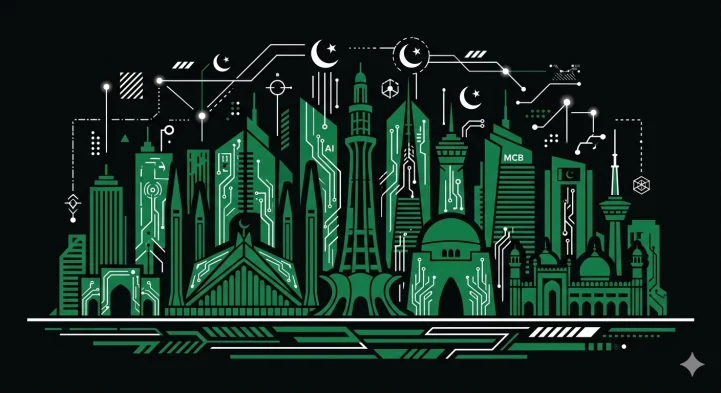
2026 is not just another year for Pakistan’s tech sector
From the outsourcing floor to the builder’s table
For a long time, Pakistan’s story in tech was a supporting role. Talented engineers. Competitive rates. Reliable delivery. The country ranked in the global top ten for freelance IT talent, and Pakistani software companies quietly built AI-powered products and ran full digital transformation programs for Fortune 500 clients, often without anyone outside the industry noticing.
But the outsourcing model, while valuable, has a ceiling. You can only scale execution so far before you hit the hard limit of not owning the product. The shift that is now underway, from providing services to building intellectual property, is the single most important development in Pakistan’s tech history.
Pakistan’s technology exports have historically been driven by software development, business process outsourcing, and freelance services. While these sectors remain important, they often generate lower margins compared to specialized AI consulting and implementation projects.
Artificial intelligence represents an opportunity to move up the value chain, enabling Pakistani firms to compete on expertise, innovation, and problem-solving capabilities rather than primarily on labor costs.
That is not a small reframe. That is a complete identity shift for an entire industry.
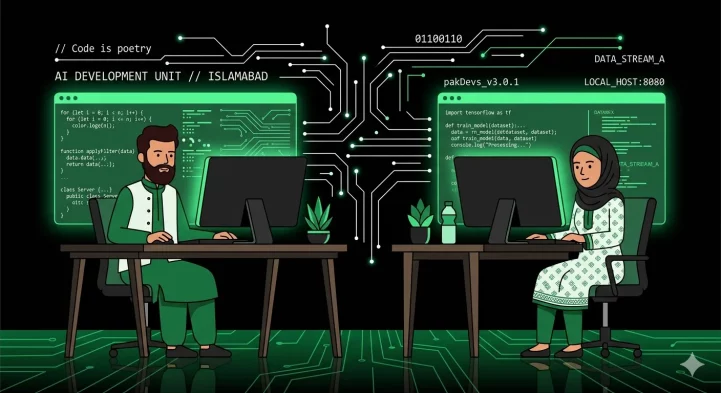
The three forces making this moment different
Three things have converged in 2026 that did not exist at the same time before.
First, the numbers. Pakistan’s IT and IT-enabled services exports reached $3.39 billion during July to March FY2025-26, recording a 20 percent year-on-year increase. Monthly IT exports rose to $413 million in March 2026, marking the second-highest monthly export figure in the country’s history. Pakistan’s PM office said IT exports are expected to reach $4.5 to $4.6 billion in the current fiscal year.
Second, freelancer earnings have exploded. Pakistani freelancers earned $557 million in foreign exchange in the first half of FY2025-26, a 58 percent increase over the same period the prior year, as AI-adjacent work commands higher per-engagement rates across global platforms.
Third, there is now a government framework with real numbers behind it. Pakistan aims to invest $1 billion by 2030 to harness the power of AI across key sectors such as agriculture, healthcare, finance, and smart infrastructure. Whether the execution matches the ambition is a separate question, and we will get to that. But the political will is real and on the record.
How Pakistani businesses are actually using AI right now
SMEs finding their footing with automation
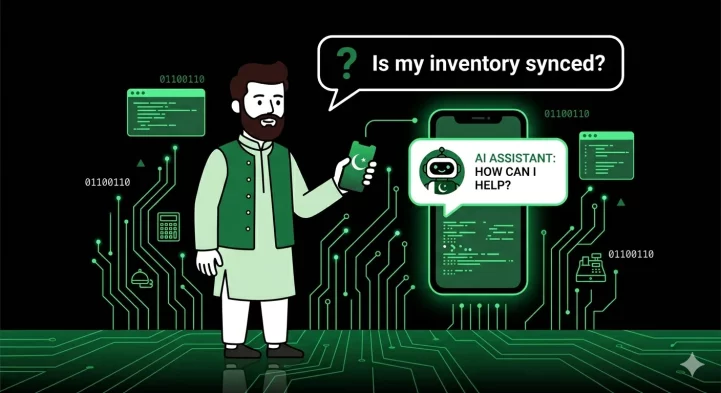
Pakistan’s SME sector is one of the most interesting untapped markets for AI adoption in Asia. These businesses run on tight margins, manual processes, and fragmented workflows. For them, AI is not a luxury. It is a survival tool.
Pakistan is attractive for B2B startups because many SMEs still run on fragmented workflows, manual records, and slow coordination, creating room for SaaS, logistics software, and procurement tools. The pain points are real and specific: invoicing that happens on paper, customer service that runs entirely on WhatsApp, supply chains managed in spreadsheets.
Early AI adoption in this segment is not about building large language models or training proprietary data. It is about automation of the basics. Chatbots handling tier-one customer queries. Accounting software with built-in anomaly detection. Demand forecasting tools for retail and distribution. None of it is glamorous, but all of it compounds.
The most important thing happening in SME AI adoption right now is the trust curve. Business owners who were skeptical of any software three years ago are now actively asking for automation. That behavioral shift is the foundation everything else gets built on.
Software companies leaning into AI as a competitive weapon
Pakistan’s software industry has always competed on price. Now it is starting to compete on capability. Global demand is shifting toward service categories Pakistan is actively building: AI integration, data analytics, cybersecurity compliance, and cloud migration, with international buyers diversifying sourcing relationships beyond single-country dependency.
What does this look like practically? Software firms are embedding AI tools into their development workflows, using them to cut delivery timelines and reduce code review overhead.
Agencies are offering AI consulting as a standalone product line, not just an add-on. And the smarter firms are using generative AI to build proprietary accelerators that make them structurally faster than competitors in India or Eastern Europe.
“Pakistan ranked 16th out of 193 countries in the 2026 Global Outsourcing Talent Index, placing it in the top 9% globally, says IT Minister”. With AI layered on top of that talent base, the value proposition to international clients keeps improving. The firms that understand this are pulling ahead. The ones still selling pure labor hours are feeling the squeeze.
Pakistani startups building AI solutions worth watching
AI-native founders making real noise globally
This is where it gets genuinely exciting.
A recent event in San Francisco showcased how Pakistani entrepreneurs and engineers are helping shape the global artificial intelligence industry, with the session titled “Building AI Products with Pakistani Talent,” hosted by Mehroz Azam, founder of Ejad Labs, to promote collaboration between Pakistan’s tech ecosystem and international investors.
At that same event, Amsal Naseem, founding engineer at Newton, highlighted how the company’s AI-driven platform is improving workflow efficiency for dental and healthcare practices, with Newton recently securing $4.6 million in seed funding to expand its operations.
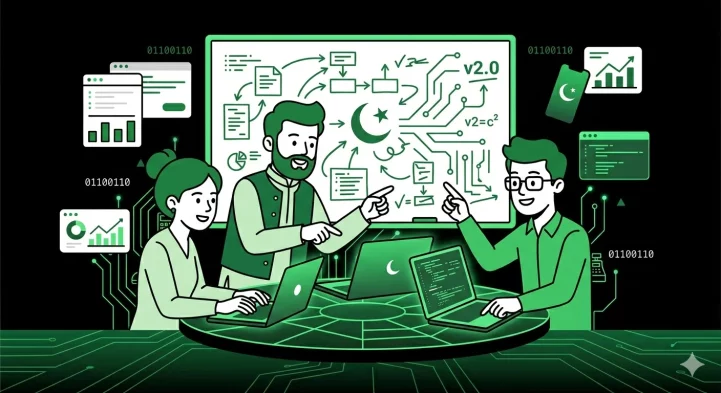
Then there is Metal. Metal, founded by Usman Gul, former CEO of Airlift, and backed by a16z and Y Combinator, uses AI to bring deep intelligence to all the core workflows involved in raising venture rounds.
The product is essentially an operating system for founders navigating fundraising, combining investor research, relationship intelligence, and pipeline management in one AI-powered layer. It is the kind of B2B SaaS product that only works if the core intelligence is actually good, and by the accounts of the YC founders using it, it is.
Local SaaS companies solving problems others ignore
Not every Pakistani AI startup is chasing Silicon Valley. Some of the most interesting work is happening at the intersection of AI and deeply local problems that no San Francisco founder would think to address.
Metric, launched by Pakistani founders Meenah Tariq, Omar Parvez Khan, and Dr. Habiba, raised funding and is expected to make an impact with their flagship “Chief Financial AI” called Max, designed to help SMEs understand their financial data, spot trends, and make smarter decisions.
This is textbook AI SaaS for Pakistan’s underserved SME segment, and it is the kind of product that could scale across the broader South Asian and Middle Eastern markets without anyone even noticing it started in Lahore.
There are also plays in edtech, healthtech, and agritech where machine learning Pakistan-style means working with low-data environments, Urdu-language inputs, and users who may have limited digital literacy.
That constraint is actually a competitive moat. Founders who learn to build under those conditions are building products that work in markets other tech companies have written off.
Funding signals and what they actually mean
In 2025, local startups raised over $74 million according to multiple reports, with fintech, healthtech, AI, and B2B SaaS attracting the most attention. Equity funding surged to levels that reflect a meaningful recovery from the post-2021 drawdown.
In the year 2026, until March, $93.5 million has been raised in five equity funding rounds across Pakistan, according to a report. That is not a Silicon Valley number. But it is a directional signal. The capital is returning, and it is increasingly flowing to companies with real products and real revenue, not just compelling pitch decks.
Growth in 2026 will increasingly favour founders who invest in governance, product depth, and regional scalability rather than pursuing rapid expansion or vanity metrics, as the ecosystem enters a phase where business-first thinking outweighs fundraising-first narratives.
In other words: the era of raising on story alone is over. Build something real or wait.
Pakistani developers building for the world, not just for local clients
Who they are and what they are shipping
Pakistan’s developer community is not a monolith. At one end, you have freelancers building WordPress sites for American dentists. At the other end, you have engineers contributing to foundational AI infrastructure at companies most people have never heard of.
Kashif Ali, founder and CEO of TaxGPT, spoke about the firm’s AI tools that automate tax and accounting tasks, with the startup raising $4.6 million to support expansion. Pakistani engineers have played a vital role in the technology development.
Qasim Asad Salam, founder of Remotebase, discussed creating global opportunities for Pakistani software engineers, with his company raising $3.5 million to help local developers work with startups in the United States, explicitly aiming to transition from providing outsourced services to building innovative products.
That transition, from service delivery to product ownership, is the throughline in every interesting story coming out of Pakistan’s developer community right now.
How Pakistan’s talent stacks up globally
The talent pool is real and, frankly, underrated by international buyers who have not worked with it. Pakistan produces over 25,000 IT graduates annually from universities including NUST, LUMS, FAST-NUCES, and COMSATS.
Many professionals hold certifications from AWS, Google, and Microsoft and have worked on international products. Cities like Lahore, Karachi, and Islamabad have developed into full software ecosystems complete with tech parks, incubators, and co-working infrastructure.
The honest limitation is the AI skills gap. Pakistan faces a significant AI skills gap, and some industry commentary puts AI-skilled workers at under 10% of the IT workforce, though this figure should be treated cautiously unless backed by a formal study.
That number needs to move significantly and quickly. Programs like AI Seekho, backed by Google and open to students, freelancers, developers, and non-technical professionals with no fees, no prerequisites, and no barriers to entry, are part of the answer, but they will not be enough on their own.
The gap between Pakistan’s raw talent base and its AI capability is the single most actionable problem in the ecosystem right now. Close that gap, and the growth trajectory becomes significantly steeper.
Can Pakistan build a self-sustaining AI ecosystem?
The infrastructure problem nobody wants to talk about
Let’s be direct. The infrastructure picture has gaps that cannot be papered over with optimism.
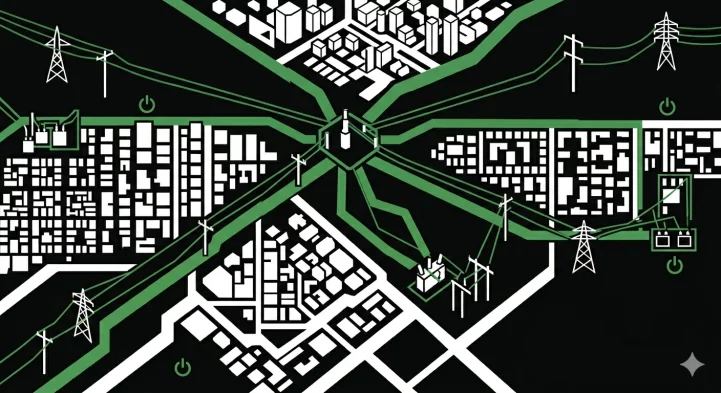
Pakistan faces chronic electricity issues, and a centralized national compute grid is therefore likely to suffer from uptime instability, rendering it unsuitable for serious research and development. AI data centers are energy-intensive.
If the power is unreliable, the compute is unreliable. That is not a software problem. It is a physical infrastructure problem that requires real investment in the grid.
The latest Government AI Readiness Index by Oxford Insights ranks Pakistan eighth of 17 countries across South and Central Asia; below India, Bangladesh, and Sri Lanka. This index scores countries across several key parameters, including government vision, digital capacity, and data infrastructure.
As of 2024, Pakistan was ranked at 97 out of 133 on overall digital infrastructure, skills and usage, and 149 out of 197 on openness of government data, reflecting limited access to official datasets for public use.
The regulatory framework is also still taking shape. The National AI Policy 2025 creates an AI Regulatory Directorate within the forthcoming framework, and the policy stresses inclusion of women, differently-abled persons, and underserved regions in the AI workforce.
Despite its lofty language, the policy’s success hinges on confronting a fundamental disconnect between vision and on-the-ground Pakistan, where foundational systems including reliable electricity, ubiquitous internet, robust data governance, digital literacy, and functional regulatory ecosystems are not currently in place.
Exporting products, not just people
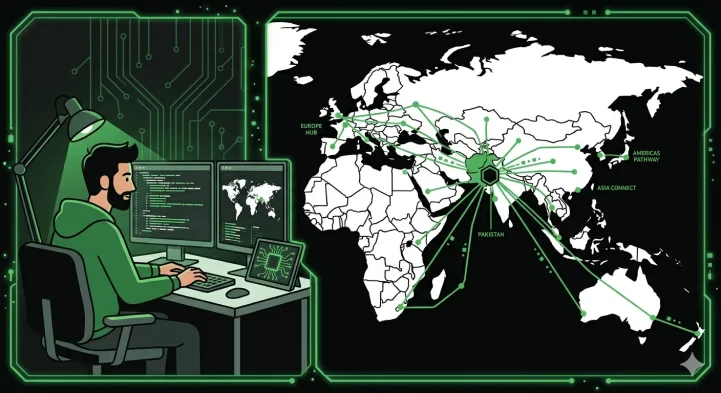
The brain drain question is the most uncomfortable one in Pakistan’s tech conversation. The country trains engineers who then go build things in San Francisco, London, and Dubai. The remittances come back, but the intellectual property does not.
Fixing this requires more than patriotism. It requires that the conditions for building products in Pakistan become genuinely competitive with building them abroad. That means reliable infrastructure, access to compute, faster regulatory approvals for tech companies, and better access to early-stage capital from local sources.
The good news is that product-focused founders are increasingly choosing to build locally or at least maintain Pakistan-based engineering teams as the core of what they ship. Several companies have developed proprietary AI systems with documented global adoption, demonstrating Pakistan’s capacity to generate intellectual property rather than solely implementing third-party solutions.
That is the model to scale.
Lessons from India, Estonia, and the UAE
Every country that has successfully built a tech ecosystem from scratch has done it differently, but the patterns are consistent.
India’s playbook was scale first, ecosystem second. The IndiaAI Mission combines a public-private compute fabric with a national dataset platform, indigenous model development, a skills pipeline, startup financing, and regulatory sandboxing. It is a whole-of-government approach executed at a population scale Pakistan cannot match. But the underlying logic, that compute access plus talent plus capital equals ecosystem, is replicable at smaller scale.
Estonia is the more instructive comparison. A country of 1.3 million people became a global model for digital government and AI-native public services by making a strategic bet on digital infrastructure early and executing relentlessly. Estonia’s approach of focusing on educational programs, including partnerships with universities, demonstrates the impact of human capital investment in developing a workforce adept in AI technologies. Pakistan has universities. It has the talent pipeline. The missing piece is the institutional follow-through.
The UAE offers a third lesson: sovereign capital allocated strategically can accelerate an ecosystem faster than organic growth alone. Pakistan has announced the $1 billion AI investment target. The question is whether that capital reaches founders and researchers through functional, low-friction channels, or gets absorbed in bureaucratic overhead.
The honest answer is that Pakistan does not need to replicate any of these models exactly. It needs to borrow the most portable lessons: fund compute access, open up government data, protect AI company IP properly, and create visa and remittance conditions that make it genuinely attractive for talented Pakistanis abroad to build from home.
Conclusion
Pakistan’s AI ecosystem in 2026 is at a real inflection point, not a manufactured one. The exports are climbing. The founders are getting global backing. The government has made an on-the-record commitment with a dollar figure attached. The talent is there.
But ecosystems do not self-assemble. The infrastructure gaps are real. The AI skills shortage is real. The regulatory framework is still being drafted. The gap between the National AI Policy’s language and the daily reality for a startup founder in Lahore is still wide.
What makes 2026 different is not that these problems have been solved. It is that the right people are finally talking about them with enough specificity to actually address them. That is how ecosystems shift: not in one dramatic moment, but in dozens of smaller ones that accumulate into something you can only see clearly in retrospect.
Pakistan is still early. But it is no longer just potential. There are products. There are revenues. There are founders with war stories and, increasingly, exits. The road to a self-sustaining AI economy is long, but for the first time in a while, it is at least visible.
FAQs
What is the current state of Pakistan’s AI ecosystem in 2026? Pakistan’s AI ecosystem is in active transition, moving from an outsourcing-heavy model toward product development and AI-native startups. IT exports are projected to hit between $4.5 billion and $4.6 billion in FY2025-26. Moreover, local AI startups are attracting international venture capital from top-tier funds including a16z and Y Combinator.
Which Pakistani AI startups are worth knowing about? Metal, backed by a16z and YC, is building an AI operating system for fundraising. Metric is developing AI-powered financial tools for SMEs. Newton is using AI to streamline healthcare workflows. TaxGPT is automating tax and accounting. These are among the most active Pakistani AI founders building for global markets right now.
How much is Pakistan investing in AI? The Pakistani government has announced plans to invest $1 billion in AI by 2030, targeting sectors including agriculture, healthcare, finance, and smart infrastructure. This sits alongside a National AI Policy 2025 with a six-pillar framework covering infrastructure, skills, regulation, and international collaboration.
What are the biggest challenges facing Pakistan’s AI ecosystem? The three structural challenges are infrastructure (unreliable electricity and limited compute capacity), talent (only 10% of the IT workforce currently holds AI skills), and data access (Pakistan ranks 149 out of 197 on government data openness). Regulatory clarity and early-stage domestic capital also remain ongoing constraints.
How does Pakistan’s developer talent compare globally? Pakistan produces over 25,000 IT graduates annually and ranks in the global top 10 for freelance IT talent. The country is in the global top 9% for outsourcing talent by quality rankings, outperforming the UK, Germany, and China. The gap lies specifically in AI specialization, which programs like AI Seekho and institutional reform are beginning to address.
Can Pakistan build a self-sustaining AI economy? It can, but not passively. The conditions for it, open data, stable compute, a skilled workforce, and founder-friendly regulation, need to be deliberately created. The comparative models from India, Estonia, and the UAE show it is possible without Silicon Valley-scale resources. The question is whether Pakistan’s institutions can execute with the consistency those countries demonstrated.